






















Increased competition among PII providers has delivered greater capacity, stability and choice for law firms. Yet the market is wary of another Axiom Ince, reports Maria Shahid, and AI use has introduced a significant element of uncertainty
The low down
The PII market appears to be a textbook example of how well-functioning markets should work. Solicitors, it seems, are now recognised as good business bets. Insurers are entering, demonstrating low barriers to entry. None are exiting. Capacity has increased. Forms are shorter, and even traditional problem areas such as conveyancing are easier to navigate. What’s not to like? Take advantage of such upsides, brokers urge. But as AI adoption increases, stay on top of supervision. Rapid expansion plans are also under scrutiny, as these featured in high-profile law firm collapses that cost the profession and its insurers dear. And why is the take-up of cyber insurance so low?
The professional indemnity insurance market remains favourable, with more insurers entering the market, none exiting, and increased capacity driving greater competition between insurers ahead of April renewals. This all spells good news for law firms. Insurers are adopting greater flexibility on terms, so that even firms with significant conveyancing practices – a specialism notorious for the number of claims it produces – have had a choice of insurers.
However, while this increase in competition has led to rate reductions, it has not necessarily led to a fall in premiums, which are influenced by a range of factors, notably a firm’s overall gross fees, brokers note. Lockton partner Marc Rowson observes: ‘Not every firm will get a reduced premium, as many firms have experienced stellar growth to their rateable fee income, but the pennies from each pound that goes toward insurance should reduce, providing that there has not been a deterioration in claims performance.’
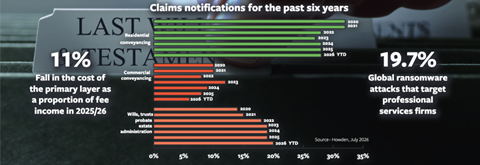
Lockton’s June market report found that the cost of the primary layer as a proportion of fee income fell by an average of 11% in 2025/26. Firms with income of £5m to £10m saw the largest reductions, at more than 15%, while the £25m-plus category saw reductions of around 12%. The report notes that there will be fluctuations between firms, subject to the area of work undertaken.
'Not every firm will get a reduced premium, as many firms have experienced stellar growth to their rateable fee income'
Marc Rowson, Lockton
However, Frank Maher, a partner at Keystone Law, warns that a softer market with lower premiums may also mean that claims will be scrutinised more closely, as margins tighten for insurers. ‘Firms need to tread cautiously, as it may lead to more coverage issues in the future,’ he says. ‘On a practical level, firms need to be careful about the process for completing the proposal form and read the declarations they are signing. They need to err on the side of caution in identifying circumstances that may give rise to claims and notify them to an insurer before renewal.’
Zarina Lawley, head of solicitors’ PI at Miller Insurance, agrees that while the ongoing soft market is benefiting firms that are attractive risks to insurers, this messaging can be overly simplistic and convey a false sense of security. ‘Firms that do not present themselves well or are not perceived to be a particularly attractive risk are not necessarily finding it easier to obtain insurance,’ she says. ‘Reductions, to the extent that they are available, will vary depending on firms’ loss ratio and current rate on fees.’

Figures published by broker Howden show that 44% of firms opted for policy terms in excess of 12 months in April 2026, compared to just 9% in 2023. ‘Almost all insurers were offering longer-term policies as standard; typically for 18 months,’ notes John Wooldridge, executive director of Howden’s legal practices group. ‘This was the case even for firms projecting significant fee income growth – circumstances in which longer-term policies would usually be less attractive to insurers, but which made the option particularly attractive to firms.’
The benefits include less administration and greater financial certainty over an extended period, he adds.
Brokers observe that more favourable market conditions have also meant that insurers are limiting the information requested. ‘Most insurers were willing to accept short-form declarations instead of requiring firms to complete lengthy proposal forms,’ says Wooldridge.
The trend towards shorter forms is driven by brokers sharing with insurers how time-consuming proposal forms can be to complete, explains Rowson. ‘The most notable addition [to the proposal form] concerns AI use. However, those that have introduced questions on this have done so seeking a summary of AI use, as opposed to a forensic questioning of firms’ AI application and strategy.’
Fallout from Axiom Ince
The collapse of Axiom Ince in 2023, which saw £60m in client money go missing, and the more recent collapse of PM Law in February, with £40m gone astray, has also led insurers to be wary of firms which have grown significantly in a short period of time, notes Howden’s Wooldridge.
‘Some insurers have started including questions in proposal forms to try [and] identify such firms. We anticipate that firms with similar profile/growth history may face reduced appetite from insurers for the foreseeable future,’ adds Wooldridge.
Insurers also remain concerned about exposure to significant consumer litigation, as well as firms whose principals are close to retirement age but do not have a robust succession plan in place, says Lockton’s Rowson.

Caution remains over insuring firms that undertake a large amount of conveyancing work. Rising property prices, higher estate values, complex family arrangements and recent tax changes have also made trusts and estates work more contentious, increasing the risk of a claim.
Howden’s July market report noted that while commercial and residential conveyancing continue to have the highest number of claims notifications, they have both been on a downward trend since 2020. By contrast, claims arising from wills, trusts, probate and estate administration continue to rise. Wooldridge says: ‘Firms undertaking this type of work should be prepared to demonstrate robust risk management measures, clear procedures and effective controls, in order to reassure underwriters that the likelihood of a claim in this area of practice is being kept to a minimum.’
AI risk guidance
A recent survey by broker Everywhen found that 41% of organisations identified AI mistakes as the biggest risk facing organisations, while 35% said that cyber is the biggest PI risk. Both ranked ahead of compliance failures, at 21%.
‘Professional indemnity and traditional risks have long been centred around human judgement – the advice somebody gives, the deadline somebody misses or the error somebody makes. Technology is beginning to complicate that picture,’ says Everywhen client director Neil D’Mello. ‘AI can be an incredibly useful tool for businesses, but using technology doesn’t necessarily remove responsibility for the outcome. If AI-generated information forms part of the advice, work or service provided to a client, businesses need to understand how that information has been produced and ensure appropriate checks remain in place.’
A recent case involving a junior associate at Pinsent Masons involved a bogus citation in a letter to the High Court. Cork & Anor v Smith [2026] concerned a block transfer of insolvency appointments. The judge found that there had been a ‘failure to supervise’ and that the letters sent to the judge were ‘misleading’. It was observed that: ‘These applications are uncontested. There is no opposing party to point out an error in correspondence sent to the court. The court is therefore particularly exposed to the risk of being misled if material is placed before it that has not been prepared with appropriate care and attention.’
Pinsent Masons has self-referred to the Solicitors Regulation Authority and agreed to meet the additional costs caused by the incident.
The SRA issued a warning notice on 17 August on the Misuse of AI, which referenced the decision in Cork. It warned that supervisors of junior lawyers may themselves breach professional duties where false citations or material get through because of inadequate review. Firms need to have ‘effective governance structures, systems and controls in place to manage any risks, including those arising from AI’, in line with the Code of Conduct for Firms.
‘AI is attracting publicity because of hallucination cases like Ayinde v Haringey [2025] [which also involved fake citations] and Cork,’ says Keystone Law’s Maher. ‘The SRA warning notice addresses these points, but in my view, there are far wider issues.’
He notes that the guidance does not address several governance risks that could result from the use of AI tools by law firms. These include bias, business continuity, deepfake output generated by AI and drafting errors. In addition, clients may impose conditions on how firms use AI.
'It is advisable to include some detail in upcoming renewal submissions on how your firm is approaching AI'
Zarina Lawley, Miller Insurance
‘At present, we have only seen limited claims exposure, mainly the risk of adverse costs orders in hallucination cases, but I think it is likely this will develop, and we may start seeing insurers looking for coverage points to take and, in due course, seeking exclusions from cover as they did with cyber,’ says Maher.
Clyde & Co partner Niya Phiri says that not using AI may become a risk of itself, with many firms taking the view that there will come a point in the future where not using AI, or not using it sufficiently, will become a claim issue. ‘There will come a tipping point where AI becomes part of assessing whether or not a solicitor has performed reasonably to the necessary standard,’ she says.

For now, with AI tools becoming increasingly embedded in legal practice, underwriters are including questions in proposal forms about their use. ‘While there have been no significant AI-related claims to date, its rapid adoption suggests this is likely to change in the near future,’ says Wooldridge. ‘Against this backdrop, firms should ensure they are well prepared to address these questions clearly when completing proposal forms.’
Lawley at Miller Insurance advises firms to start preparing now for the SRA’s likely sharpened focus on AI tools: ‘It is advisable to include some detail in upcoming renewal submissions on how your firm is approaching AI, referencing policies, procedures, risk controls and training.’
Enhanced protection and doubling up
Excess cover softens
Under the SRA’s minimum terms and conditions (MTCs), sole practitioners and partnerships must have cover of £2m in place, while incorporated firms are required to have £3m. For firms more exposed to claims, such as conveyancing and private client, amounts can be higher, making an excess layer beneficial.
‘As with the primary layer, the excess layer market has experienced a notable increase in capacity, which has driven continued rate improvements,’ says John Wooldridge at Howden. ‘We anticipate further reductions in both the lower excess layer space (up to £10m) and also for levels above £10m.’
Co-insurance
Participating insurers have shown a growing interest in underwriting firms on a co-insured basis. This applies where two or more insurers share the risk, with each insurer underwriting an agreed percentage of the total coverage.
Wooldridge notes that this trend is particularly evident for larger firms with annual premiums of six figures or more.
‘There has been a change in how both the participant and the provider are viewing their arrangements, even at primary level,’ says Clyde & Co partner Niya Phiri.
Cyber cover
Law firms often hold highly confidential and sensitive data on their clients, alongside client monies. Conveyancing firms in particular are often prime targets for cybercriminals, with large amounts of money being transferred in even the most mundane transaction.
Ransomware remains one of the most common threats. In May, US firm Weil, Gotshal & Manges was reportedly targeted by hackers, who obtained confidential client information which they threatened to publish. The firm is understood to have made a payment in the region of $18-$20m to prevent this action.
‘Cybersecurity remains a key risk, with attack methods becoming more sophisticated, and AI also being used by bad actors,’ says Simmons & Simmons partner Michelle Allison.
Globally, a 2025 survey carried out by ransomware response firm Coveware found that ransomware attacks disproportionately affect certain industries, with professional services facing the highest share at 19.7%.
Despite this rise in risk, take-up of cyber insurance remains relatively low, say brokers. ‘Options for cyber insurance continue to be provided in abundance; the supply far outweighs the demand,’ says Rowson. ‘Take-up is below 25%, which means a significant number of firms have unprotected exposure.’
Lawley says: ‘We have noticed that the largest firms have upped the ante in terms of investment in legal technology, including strategic investment in robust cyber defences. It doesn’t make them immune to major cyber incidents, but it often reduces the long-term impact of many incidents.
‘This isn’t to downplay the seriousness of cyber risks. It is common knowledge that the number and sophistication of attacks has increased exponentially. However, SME firms that perhaps don’t have the same level of investment in security are potentially more vulnerable. An area that is also still not sufficiently considered is law firms’ increasing reliance on third-party systems, and the business impact if a key supplier suffers a major incident.’
Brett Dixon, vice president of the Law Society, confirms that cyber risk is an increasing concern across the profession: ‘While we have not seen a widespread increase in cyber incidents due to AI, firms should not be complacent.’
Dixon advises: ‘They should review their cybersecurity protections and update staff training to include emerging AI risks and consider whether standalone cyber insurance is needed. Our cyber insurance guidance provides essential, targeted advice to help solicitors assess their specific risks and ensure they have the necessary level of protection.’
Supervision post-Mazur
The landmark Court of Appeal judgment in CILEX v Mazur [2026] clarified that an unauthorised person (such as a legal executive, paralegal or trainee solicitor) may perform litigation tasks for and on behalf of an authorised person, provided there is proper direction, management, supervision and control.
The Law Society has since explained that the Court of Appeal judgment is not ‘a simple return to the position prior to the High Court judgment’. Instead, it noted that the appeal ruling ‘repeatedly emphasised the need for a close and substantive supervisory relationship between the authorised individual and the unauthorised person’.
The SRA revised its effective supervision guidance following the March judgment, explaining how the existing rules should be applied after Mazur.
'Not all claims arise because of bad supervision, but it can sometimes be a contributory factor'
Niya Phiri, Clyde & Co
Simmons & Simmons’ Allison observes: ‘The SRA stresses [in the guidance] that supervision arrangements must be risk-based, appropriate to the complexity of the work, proportionate to the experience of the person (or system) carrying it out, and capable of being evidenced.’
The practical focus has therefore shifted from whether work can be delegated, to whether a firm’s supervisory arrangements are sufficiently robust. Maher says: ‘I have had a number of firms instruct me on the adequacy of their supervision arrangements post-Mazur.’
Phiri at Clyde & Co explains that supervision was already under scrutiny before Mazur, because it is often one of the gateways to mitigate risk and claims. ‘Not all claims arise because of bad supervision, but it can sometimes be a contributory factor, and I think it can present itself in different ways in claims,’ she says. ‘So we are seeing firms take a lot of different practical measures to try and counteract that, whether through capacity management systems, how they are incentivising their staff through the chargeable-hour model, because sometimes behaviours are caused by people trying to fill their timesheets, and also what levels of file audit, peer review, “four eyes” approaches they have on different documents. I think firms are seeing this as a much more active issue, that they have to have under consideration.’
Lawley says: ‘Two areas that firms should also be alert to are ensuring that meaningful supervision is still in place in niche teams where a particular fee-earner may have a specialised practice, and ensuring supervision is not just about reviewing junior fee-earners’ files.’
The costliest claims, she adds, ‘typically arise from senior fee-earners’ work. Being able to evidence multiple points of review and/or a peer review at critical junctures of high-risk matters, regardless of seniority of the fee-earner, can help demonstrate a strong supervision culture. Firms are definitely getting better at this, and it’s an area where evolving legal tech is also helping firms embed this more effectively’.
The way forward
Lawley notes that the current PII market is not simply about price: ‘While price is an important consideration, firms should use the softer market as an opportunity to review their insurance coverage, obtain enhanced wordings and change excesses. Simply chasing the best price can lead to short-term decisions with longer-term repercussions.
‘We would encourage all firms to talk to their brokers about what sufficient cover looks like for their individual circumstances, taking account of the types of work they are doing and plan to do, and the types of clients they are working with.’
While capacity is expected to remain strong for the rest of 2026, and no insurers are expected to leave the market, Wooldridge at Howden warns that the increase in claim notifications over the last three years may lead to a change in market conditions. ‘While this [increase in claims] does not necessarily signal an imminent change, it may suggest that the current soft market will prove shorter-lived than the previous cycle. Only time will tell.’
Maria Shahid is a freelance journalist








No comments yet