





















It is difficult to describe a typical day/week in Army Legal Services. Each role is different and we change postings every two years or so. Unlike other legal jobs, my career in the army started with training at the Royal Military Academy Sandhurst before completing an infantry attachment with 1 Royal Gurkha Rifles. This focused on developing my military or ‘green’ skills.
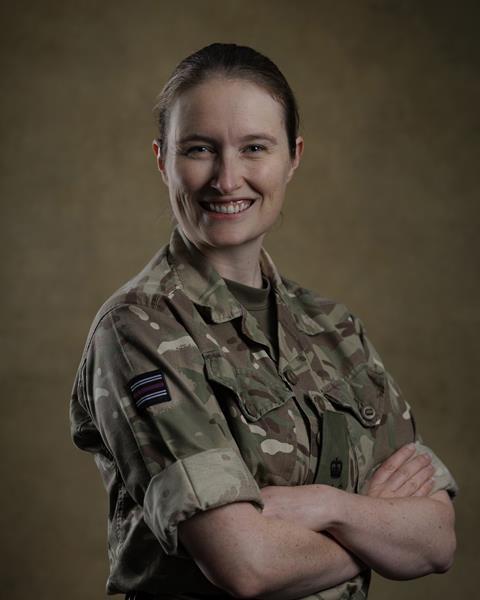
My first legal role was based in Germany and involved advising on family law and financial matters. I then moved back to the UK and spent the next two years prosecuting at court martial (including a short secondment to the Attorney General’s Office) before moving into more operationally focused roles. This culminated in my deployment overseas on operations. My current role is as part of the legal team advising on service complaints and other employment law-related matters.
My venture into the British army was not planned. I had no idea that the army had lawyers until, by chance, I saw an advert in the Scottish Legal News. I knew very little about the army but had always been attracted to the idea of public service and contributing more to society.
I was completely unaware of the variety of opportunities presented by ALS. However, with every stage of the application process, I became more and more convinced that it was the right role for me. I enjoyed the challenge of the Army Officer Selection Board but, more than that, it was the welcoming nature of all the people I met.
'Once on exercise I had to explain the intricacies of international law to a commanding officer while standing in the middle of a desolate field in the rain'
I had trained and worked post-qualification at a specialist litigation firm in Edinburgh. My traineeship covered the spectrum of litigation, from personal injury to commercial disputes. I focused post-qualification on professional negligence litigation and medical regulatory cases. I was initially concerned that my lack of military experience or any obviously relevant legal experience may act as a barrier to joining ALS. However, I was quickly reassured that this wasn’t an issue. I had transferable legal skills that would provide a solid start, but ALS was on hand to help me become a military lawyer. I loved my role (and my team) at the legal firm, so I had not planned to leave, but the opportunity of a commission with the ALS was too good an opportunity.
I have now been in ALS for over 10 years. The role has presented more opportunities than I could ever have imagined. I have expanded my legal practice, gaining expertise in international law through both on-the-job training provided by ALS and additional educational opportunities. ALS funded my completion of an LLM in International Law and Conflict from the University of Reading, for which I achieved a distinction. Their support has also enabled me to enhance my knowledge of domestic law. They encouraged me in my desire to dual-qualify in the law of England and Wales and thereafter funded my qualification as a solicitor-advocate in criminal law.
I have lived in Brunei and Germany and worked around the world, both on deployment and military exercises with other UK personnel and partner forces. I have also attended legal training courses in the US, Italy and Croatia, and dramatically improved my skiing abilities through several adventurous training trips in France and Austria. As with all legal roles, there are challenges. I particularly remember one moment on exercise where I found myself having to explain the intricacies of international law to a commanding officer while standing in the middle of a desolate field in the rain – but those only add to the experience.
ALS covers three broad areas of legal practice. The first is advisory, which involves advising the chain of command on matters such as disciplinary and administrative law. Second, prosecutions, where legal officers represent the Crown at court martial. Third, operational law, covering areas such as the law of armed conflict and human rights law. Because we move between roles every two years or so every legal officer must have a broad range of legal knowledge, covering each of our core areas, with the agility to apply it to whatever circumstances present themselves. This requires an in-depth knowledge of both the law and the army – we may be lawyers, but we are also officers. Not only does this make the role of an ALS legal officer unique when compared to other in-house or private practice roles, but it is one of its most attractive attributes. Every day is different.








1 Reader's comment