























The law relating to consent involving deception is a ‘mess’, but there are no simple solutions.
The low down
Later this year, the Law Commission will review the way the criminal law deals with the issue of consent. One focus will be deceit relating to consent in alleged sexual offences. The law once took a broader approach to sex by deception through the offence of ‘Procurement of a woman by false pretences’ under the Sexual Offences Act 1956. This was abolished by the 2003 version of the act, which has narrowed the circumstances in which deception will vitiate consent. The courts have struggled to interpret the law in a way that is clear and consistent, and most practitioners agree that reform is needed. But there are no easy answers.
James lies to Mary to get her to sleep with him; he knows she would not consent to sex if he told her the truth. Has James committed a criminal offence? The question of whether this behaviour falls under the Sexual Offences Act 2003 is not easy to answer. The legal position on consent involving deception is confused and unclear, and the Law Commission will examine this later in the year.
‘The law is in a mess,’ says Paul Jarvis KC, barrister at 6KBW College Hill. Jarvis is a member of the Criminal Law Reform Now Network (CLRNN), which put together detailed proposals for reform of this area of law in 2023. ‘Not only is it in a mess, but we’re seeing cases regularly where this issue is raised. Only this year, we had one [concerning] whether somebody pretending to be asleep and video recording their partner amounts to the removal of their consent by the act of deception. So it is coming back time and time again.
‘People are struggling to understand why our law in relation to consent to sexual offences is incapable of accommodating conduct which I think most people, objectively speaking, would say is wrong. But there’s no mechanism to punish those who act in a way that deprives you of any autonomy over your own body. Just because it’s a lack of autonomy derived from deception, we ignore it. If it were a lack of autonomy coming from threats or coercion, then we would seek to penalise that.
‘When it comes to property rights, telling lies to get your hands on people’s possessions is a crime, and has been for a very long time. But lying to get your hands on someone’s body is not an offence. I find it very difficult to reconcile that as a proposition.’
After asking the public which areas it should review, last year the Law Commission selected ‘consent in the criminal law’ as one of 10 topics in its 14th programme of reform. As the commission pointed out, it is an area where the government has expressed a ‘serious intention’ to change the law, which is ‘unsettled, incoherent and unpredictable’.
The commission said: ‘Faced with unusual fact patterns, the courts have struggled to achieve a consistent answer to questions about the effect of deceit on consent. Social attitudes have also continued to evolve, though rarely do they pull in one direction.’
The key legislative provision on consent to sex is in section 74 of the Sexual Offences Act 2003, which defines consent as agreeing ‘by choice’, with the ‘freedom and capacity’ to make that choice. In relation to deception, the act says consent will not be valid where the complainant is intentionally deceived as to ‘the nature or purpose of the relevant act’, or where the accused impersonates someone ‘known personally’ to the complainant. Meanwhile, the 2003 act repealed sections of the earlier Sexual Offences Act 1956 which provided for the broader offence of ‘Procurement of [a] woman by false pretences’. This left a gap in relation to sex by deception that the courts have struggled to fill in a consistent and understandable way, dealing with some very different situations.
For example, the courts have held that if a man were to remove a condom without a woman’s knowledge, when it was clear she would not agree to sex without it, this would amount to rape (Assange v Swedish Prosecution Authority [2011] EWHC 2849 (Admin)). Likewise, in a case where a man deliberately ejaculated inside a woman, having promised not to, the courts found this fell within the definition of rape (R (on the application of F) v DPP [2013] EWHC 945 (Admin)). However, where a woman’s partner lied about having had a vasectomy so she would have unprotected sex, the court ruled that her consent had not been negated because she had not been deceived as to the ‘sexual intercourse itself’, but only the ‘broad circumstances’ surrounding it, namely the man’s fertility (Lawrance [2020] EWCA Crim 971).
'The law is inconsistent, it’s sexist in its application and it’s in need of reform'
Harriet Wistrich, Centre for Women’s Justice

Several cases have involved deception regarding the defendant’s gender (so-called ‘gender fraud’ cases), with the first being McNally [2013] EWCA Crim 1051. The courts have held that deception relating to gender does vitiate consent.
What about where the defendant is not who they say they are? This was considered in R (Monica) v Director of Public Prosecutions [2018] EWHC 3508 (Admin), where ‘Monica’ had a sexual relationship with an undercover police officer, believing him to be a fellow environmentalist. She maintained that she would never have entered into any sort of relationship with him had she known the truth, and she felt abused. She brought judicial review proceedings against the DPP for not prosecuting the police officer for rape. The court rejected this, and found the DPP was justified in deciding not to prosecute, as his deception was not ‘closely connected’ to the nature or purpose of the sexual activity.
Dr Jonathan Rogers, associate professor at Cambridge University and co-director of CLRNN, observes that the current law only catches deception that the courts consider ‘very closely related to the physical act’. He adds: ‘That’s the unsatisfactory position we see now, whereby if a man lies about having a vasectomy, he’s in the clear; whereas if he goes about his task of getting unprotected sexual intercourse with a different lie, i.e. that he’s going to wear a condom, that’s the other side of the line because that might be closely connected with the physical performance of the act. That makes no sense.’
Solicitor Harriet Wistrich, founder of the Centre for Women’s Justice, who acted for ‘Monica’, adds: ‘There are a lot of inconsistencies on a commonsense level in what circumstances something is a crime and in what circumstances it is not. Not only that, but women also seem to be prosecuted more – say, for [gender fraud]; whereas with serious deception as to identity by police officers using their powers, or men who cause harm through reproductive coercion and those sorts of issues, there is no way of holding those men criminally accountable.
‘So the law is inconsistent, it’s sexist in its application and it’s in need of reform. Although the extent to which you bring the criminal law into all these cases is up for some discussion, analysis and debate.’
Cover stories
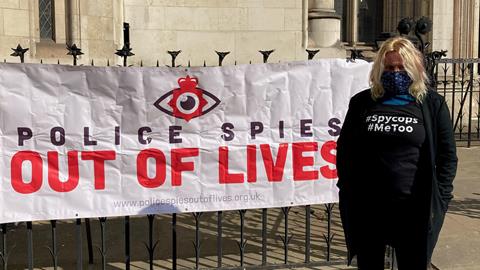
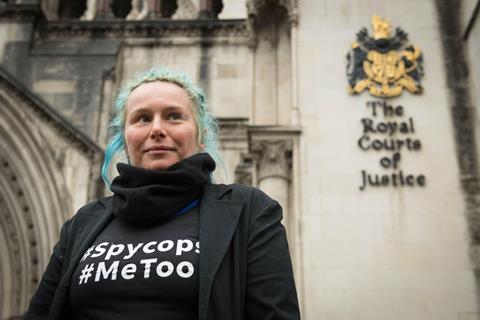
In 2015, a series of revelations about the conduct of undercover police officers dubbed ‘spy cops’ prompted widespread outrage. Home secretary Theresa May set up a public inquiry into undercover policing since 1968, which is still ongoing.
Campaign and support group Police Spies Out of Lives alleges that over more than four decades, the police sent 140 undercover officers to spy on more than 1,000 political groups.
In 2015, the Metropolitan Police publicly apologised and paid substantial compensation to seven women who were deceived into forming ‘abusive and manipulative’ long-term relationships with undercover police officers. In 2022, environmental activist Kate Wilson, who was deceived into a two-year intimate relationship, won a landmark case in the Investigatory Powers Tribunal, which ordered the Met and the National Police Chiefs’ Council (NPCC) to pay £229,472 in compensation for breaches of her human rights.
The Guardian has reported that four undercover officers are alleged to have fathered children while using their false identities.
A new offence?
That discussion was thoroughly conducted in 2023 when the CLRNN undertook an extensive research project in this area, led by Jarvis. The project culminated in the drafting of a proposed new criminal offence, ‘inducing a person to engage in sexual activity by deception’, to potentially be added to the Sexual Offences Act 2003 (see the CLRNN website for the full offence).
How would it work? In essence, it would be a crime for person A to deceive person B in order to get them to engage in sexual activity which then takes place as a result. Controversially, the subject matter of A’s deception could be anything – their marital status, their religion, what they do for a living. The key thing is that A knows, or believes, that what they are lying about (or failing to come clean about) is a dealbreaker in terms of B’s decision whether or not to have sex with them.
The draft offence does not involve the concept of consent; there is a further element designed to guard against overcriminalisation. For the offence to apply, A must have no ‘reasonable excuse’ for their deception. What amounts to a reasonable excuse would be up to a jury, but it lists relevant factors, including B’s age and vulnerability, the risks of serious consequences for B, A’s age and immaturity, any other purpose A might have for lying, and the personal and private nature of the subject matter of the deception.
‘Our proposed offence may not be perfect, and it does have its critics,’ says Jarvis. ‘But this has been a difficult area for a long time. Various law reform bodies over the years have recognised the problem and never sought to promote a solution. We’ve formulated what we think would be a credible offence to capture this sort of misconduct, as a starting point – and hopefully as a way of inspiring the Law Commission and the Ministry of Justice to think carefully about this as an issue.’

For many people, the idea that someone could find themselves in the criminal courts after lying about being married might be a step too far – criminalising behaviour that is, one suspects, all too common. Why not exclude certain categories of lie, which the public might regard as unsuitable for the criminal law?
‘The focus is on protecting individual autonomy,’ explains Jarvis. ‘If we automatically put a red line through certain things, we’re essentially saying, we don’t think this is important enough for it to matter to you… your autonomy doesn’t matter when it concerns certain misrepresentations.’
For Wistrich, CLRNN’s proposal is ‘a good working idea’, but the open-ended nature of what a deception could be about – someone’s wealth, their relationship status, their profession – is ‘a bit tricky’. She says: ‘The counterargument is, well, people deceive each other all the time in sexual relationships. You can’t start criminalising what is quite commonplace, particularly by men, but sometimes by women as well. I have some sympathy [for not] having the criminal law interfere every time somebody decides to lie to their partner. On the other hand, where the lie, and the results of that lie, have very serious consequences – for example, [as in some cases involving undercover police officers], where somebody has a child – there are arguments for some form of criminal accountability around those sorts of lies, where the consequences have huge ramifications.’
The CLRNN is an influential law reform group that has a memorandum of understanding with the Law Commission to facilitate the exchange of ideas. It is fair to assume that its draft offence will be looked at closely as part of the commission’s review. Could it really ever come into law, however?
Rogers acknowledges that the issue of ‘what does the public think of a lying spouse being hauled up before the courts’ could prove politically problematic. ‘That sort of reasoning may see it rejected without a second thought; that’s a risk,’ he admits.
Jarvis observes: ‘The reality is that you’ll have these examples around the edges. But there are lots of examples where quite serious deceptions are being perpetrated, such as relating to sexual health or fertility, where people would say that this kind of deception really would worry me. Why aren’t we doing something about it?
‘What will probably happen is that there’ll be interest in creating an offence around a model not dissimilar to ours. But the big debate is, will certain deceptions be carved out of it... We might end up with some sort of compromise, whereby the offence ends up having a number of exceptions built into it, to cater for the types of conduct where the public might not be entirely comfortable with the idea [of criminalising them].’
Wider reform
'For some time, it feels like public policy has been focused on trying to increase the conviction rate, rather than trying to find something that actually works'
Sandra Paul, Kingsley Napley
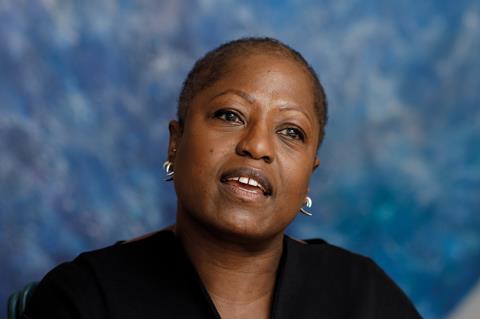
For defendant lawyer Sandra Paul, partner at Kingsley Napley, the considered mechanism of the proposed offence to cover sex by deception, with its ‘checks and balances’, is precisely the kind of thinking needed in this area of law. ‘It’s that kind of cleverness and nuance that we need here,’ she says. ‘It’s about how do we work together and find a nuanced solution to the problem.’
Paul would like to see similar fresh thinking brought to bear on much broader, bigger reform to the law concerning rape. ‘For some time, it feels like public policy has been focused on trying to increase the conviction rate, rather than trying to find something that actually works,’ she says. ‘The approach should be bolder. The Law Commission should be looking at this as a unique opportunity to say, “let’s reimagine this”.
‘We’re talking about such disparate circumstances – from being pulled off the road by a stranger, to a less-than-enthusiastic 30-year relationship where you go, “well, go on, then”,’ she explains. ‘You’re trying to create rules that apply to all those different situations. I’m not sure there’s another area of law where you have to deal with so many different iterations.’
Paul notes that in relation to murder, for example, there are different versions of the offence: murder, manslaughter and gross negligence manslaughter. ‘Why aren’t we looking at having degrees of this [rape] offence?’ she asks. ‘How do we deal with someone being pulled off the street, versus a boyfriend and girlfriend, where he’s 18 and hasn’t properly judged, and has too much to drink… We’re tinkering with something that needs real help, and the difficulty we’re creating is very important, because in among those cases, there is that variety of things that are something more akin to a level of culpability nearer to negligence, versus a deliberate attempt to hurt someone. It’s problematic; somebody gets hurt on both of those. But how do we deal with it?
‘At the moment, someone who is at that end of the continuum – “I didn’t mean to hurt anybody, I genuinely thought this was something that they wanted” – they plead not guilty, we put them in a queue and wait three years to have a trial about it. Whereas actually, if we thought about it, there might be a better way of dealing with this.’
Paul suggests that, as a society, we should agree on ‘how we want to regulate this aspect of conduct’. She explains: ‘Some of it, there’s nothing to have a discussion about – a forced situation where the issues are clear; it’s so obviously wrong. But the things we’re having difficulty with, that are filling up our courts, are those other ones, the relationships, the one-night stands, the unguarded liaisons – where there is more nuance, there is an explanation as to why this happened, and the court is trying to navigate making a decision.
‘We’ve got into a position where we can’t have an honest intellectual or legal discussion about this – which means, how do we ever find the correct solution to this problem? It’s really difficult, but we do need to think about it.’
Returning to the issue of sex by deception, Jarvis also hopes to spark a discussion. ‘One of our purposes in [drawing up a proposed offence] was to at least begin a conversation about what it might look like,’ he says. ‘Previously, it was in the too-difficult-to-do-anything-about drawer for 50, 60 years.
‘So the more people we can get talking about it – whether they agree or disagree passionately – the better.’
Rachel Rothwell is a freelance journalist and Gazette columnist








No comments yet