






















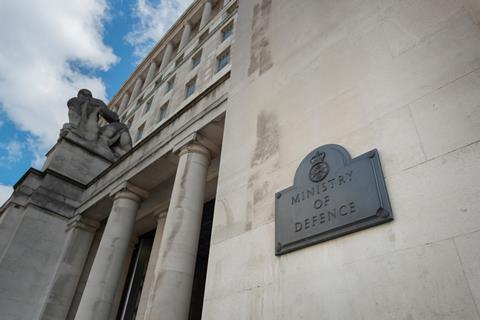
The Ministry of Defence will only have to pay 60% of claimants’ costs after a judge said both parties in group litigation had been partially successful.
Mr Justice Garnham handed down judgment in April on a series of generic issues raised in thousands of claims for damages for noise induced hearing loss by members of the armed forces.
The claimants, represented by national firm Hugh James, then asked the court in Abbott & Ors v Ministry of Defence to order the MoD pay 95% of common costs and to make a payment on account of around £6m. The MoD resisted any such order, contending that the outcome of the trial was ‘genuinely mixed’ and so it should not have to pay the costs usually recoverable from an unsuccessful party. The judge made an interim order for payment on account of around £2.5m.
The judge accepted that the claimants were ‘very largely successful’ on the major issues at stake, which had attracted most attention and required most work in the trial. But he cited specific areas where the defendant had won the argument and found that the costs award should reflect this.
The ruling explained that the litigation had been running for a decade and its overall value could run into the billions, with as many as 100,000 military personnel affected.
Christopher Lambie and Jack Craggs, two former soldiers, brought the test claims and succeeded in obtaining ‘substantial’ awards of damages: Lambie for loss of earning capacity and Craggs for his tinnitus.
The judge said Lambie’s case in particular was relevant to the whole cohort and that the loss of future earnings – which had been argued for – would be the single most significant element of the damages claims in a sizeable proportion of other cases. But as the MoD avoided a much larger award for loss of future earnings, the effect of this part of the ruling was ‘overwhelmingly positive’ for the defendant.
The claimants succeeded on what the judge described as the major issues in the litigation, including foundational concepts, the preferred diagnostic method and the approach to quantification.
But the judge further found that the MoD had been largely successful on several issues: utility of military audiometry, latency, acceleration and cochlear synaptopathy.
It is possible that a large number of claims will now be settled, but where these medical theories were cited such claims may be abandoned.
The judge added: ‘I can see it as possible that a number, out of the tens of thousands who have intimated a claim, may be dissuaded from continuing by my findings.’
After the substantive ruling in April, Hugh James said the court had unlocked compensation for military deafness claims and urged the government to begin settlements.
Partner Simon Ellis said: ‘The Ministry of Defence has already acknowledged that it owes a duty of care to service personnel, many of those with hearing loss have already waited years for answers. Now is the time for them to come to the table and work out a scheme to agree compensation and avoid a further lengthy and expensive legal dispute.’
This article is now closed for comment.





1 Reader's comment