






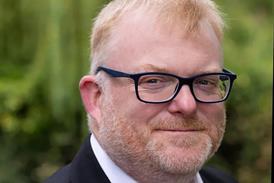
















Judges in the United States who are upholding the rule of law in the face of serial attacks by the Trump administration will be vindicated by history, a former US bar chief has claimed. Some on the bench are facing not just intimidation but threats of physical assault for ruling against Republican interests, the IBA’s Rule of Law symposium heard today.
Deborah Enix-Ross, president of the American Bar Association from 2022-2023, is a senior adviser to the international dispute resolution group at Debevoise & Plimpton.
‘What we’re seeing in the US is an attack on democratic institutions, including the courts,’ she told delegates. ‘But I will say this. When the history of this time in the US is written, it will be the judges who are the heroes. The judges are going to work every day..knowing the pressures that they’re under, knowing the threats that they are receiving - not just them personally, but their staff and their families - and they are still showing up.’

Enix-Ross said she is ‘extremely proud’ of the way that the ABA has stood up for the rule of law on behalf of law firms and the legal profession, ‘in some instances, at great expense and cost’. She also praised other national bars for lending their support. ‘When we stand together as a legal profession for what we know is right, even at personal cost to us, that is the only way that we are going to preserve not just the rule of law, but a just rule of law.
‘Let us in the US be your cautionary tale,’ she told delegates.
Alberto Mora, former general counsel, US Department of the Navy, agreed that democracy in the United States is in ‘deep trouble’ under its present authoritarian leadership. ‘The international system that emerged after the Second World War was shaped in significant measure by Franklin Roosevelt, Winston Churchill and the Allied Powers,’ said Mora. ‘They understood the causes of the war: unchecked power, disregard for human rights, failures of democracy and failures of collective security. The post-war order they constructed was designed to address those failings through international institutions, human rights protections, international law and alliances capable of preserving peace and stability.
‘That system is now being dismantled. Trump’s rhetoric and policies reflect a more imperial conception of power based on spheres of influence and a retreat from longstanding American commitments to democracy promotion, the rule of law and human rights abroad.’
Mora echoed Enix-Ross in noting that Trump has repeatedly attacked judges and courts when decisions have gone against him. ‘This has created an atmosphere in which judges have been subjected to threats and intimidation,’ said Mora. 'Yet despite these pressures, the judiciary remains one of the brighter points in the American democratic system. Trial judges across the country have generally demonstrated fidelity to the law and considerable personal courage in continuing to discharge their responsibilities.'
Mora voiced the hope that the forthcoming midterm elections could ‘alter the balance of power in Congress and restore some of the legislative oversight that has weakened in recent years’. He concluded: ‘If that occurs, Congress may once again play a more robust role within the constitutional system of checks and balances. The stakes are extraordinarily high, not only for the United States but for the wider world.’
An afternoon session of the symposium on the Lawfare phenomenon addressed Trump’s legal campaigns against his political adversaries. Kelsi Corkran, Supreme Court director of Georgetown Law School’s Institute for Constitutional Advocacy and Protection, addressed the growing weaponisation of the courts.

Corkran spoke in favour of a proposal floated last year by two academics for an unprecedented 'prosecutor jury' system that would evaluate indictments against politicians, as concerns grow that prosecutions are increasingly fuelled by partisan motives. Ian Ayres, a professor at Yale Law School and Saikrishna Prakash, a professor at the University of Virginia School of Law, proposed that this panel consist of 20 randomly selected former US attorneys, evenly divided between those nominated by Democratic and Republican presidents.
Corkran also fiercely criticised the law firms that capitulated to Trump over representing clients or causes the president did not like - agreeing to do pro bono work for the administration to escape sanctions.
'That was a really dangerous moment in the United States in terms of democratic backsliding,’ she said. 'There were also other law firms who saw the weakness and attempted to poach partners. It reinforced the idea that the Trump administration could retaliate in this way against its enemies and that they would respond by bending the knee. Fortunately, a number of other law firms fought back and got court orders saying that the executive orders were unconstitutional. And my impression is those firms are doing quite well financially. So maybe karma is a real thing.'









No comments yet