






















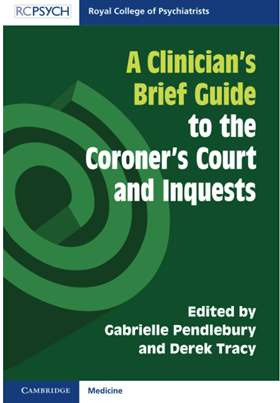
A Clinician’s Brief Guide to the Coroner’s Court and Inquests
Edited by Gabrielle Pendlebury, Derek Tracy, South London and Maudsley NHS Foundation Trust
Cambridge University Press, £24.99
★★★★★
Dr Gabrielle Pendlebury and Professor Derek Tracy have written a clear, concise and practical guide to the coroner’s court and the inquest process. What stands out most is how approachable the book feels: it explains this specialist area in a way that is easy to follow, even for readers with little or no experience of inquests.
The book begins by stripping the coroner’s court back to its historical context before explaining its modern role, jurisdiction and procedure. That foundation is particularly useful for clinicians, who may understand the medical circumstances surrounding a death but be unfamiliar with the legal framework in which their evidence will be examined. Among other areas, the book covers expert witnesses, legal perspectives and the management of outcomes, giving the book a useful breadth, without making it feel unwieldy.
The format is accessible and easy to navigate. Relevant legislation and statutory duties are consistently identified, with useful explanations of how and when particular obligations are engaged. References to precedent are helpfully separated into extracts alongside the main text, allowing readers to understand the practical significance of the authorities without interrupting the overall flow.
The book's strength is its practical emphasis. It is particularly helpful to those dealing with preparation: how to approach and draft a statement, how to give evidence, and how to manage the experience of appearing before a coroner. This is not merely an account of coronial law; it is a guide to the expectations placed on witnesses and to the professional judgment required before, during and after an inquest.
My favourite feature is the accompanying Inquest Assist online resource. The online programme provides five courses and, on completion, gives clinicians access to a coroner’s court preparation checklist. It is a thoughtful addition which extends the book’s usefulness beyond the written page into an interactive tool to aid with learning.I would strongly recommend this guide to professionals preparing for their first appearance at an inquest, as well as anyone considering a career involving coronial law. It provides a clear foundation in both procedure and practice.
Skye Blackshaw is a council member at Medico-Legal Society





No comments yet