





















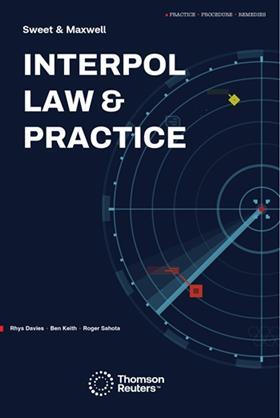
Interpol: Law and Practice (1st edition)
Ben Keith, Rhys Davies, Roger Sahota
£99, Sweet & Maxwell
★★★★★
Interpol is probably better known than it is understood. For most people, and perhaps even for some lawyers, the words ‘Interpol Red Notice’ carry a cinematic impression of international arrest, global police powers and rather serious consequences. The reality is more legally nuanced – and understanding that nuance can prove surprisingly difficult.
The problem is not necessarily a shortage of material. Law and practice points are dispersed across international instruments, domestic law, Interpol’s own rules, case law, and the wider fields of extradition, immigration, asylum and human rights. This book sets out to bring those strands together in a single work aimed squarely at the practitioner.
The first part deals with Interpol and the Notice System, providing the institutional and legal framework necessary to understand how the machinery operates. That foundation is important. A Red Notice is neither an international arrest warrant nor a self-executing instrument of arrest. Its practical significance depends on the law of the jurisdiction in which the individual is found. This study helps to disentangle those distinctions without losing sight of their practical consequences.
Its treatment of the Commission for the Control of Interpol’s Files (CCF) is particularly valuable. For the practitioner, the important questions are likely to be practical: what information has been circulated, on what basis; whether it complies with the applicable rules; and what avenues exist to challenge it. Bringing CCF practice and procedure into the same volume as the wider Notice System gives the reader a much clearer picture of how those questions can be approached.
Interpol has the curious distinction of being an institution almost every criminal lawyer has heard of but relatively few have had properly explained to them. The authors’ aim to lift the veil on the processes is therefore very welcome, particularly given the very different legal systems and cultures of policing involved. What may appear straightforward within one jurisdiction can look rather different through the legal or policing culture of another.
The broader legal landscape is sensibly addressed alongside the core Interpol material. Extradition, immigration and asylum are not merely adjacent subjects. They may determine what happens to an individual who becomes the subject of an international alert. The book therefore provides useful context for understanding how Interpol mechanisms interact with domestic legal systems.
For criminal, extradition, immigration and human rights practitioners, this book fills a conspicuous gap in the literature. Its achievement is to take a system which can appear opaque from the outside and make its structure, procedures and potential remedies easier to understand.
Piers Desser is a solicitor specialising in complex crime and international investigations at Carson Kaye Solicitors, London









No comments yet