























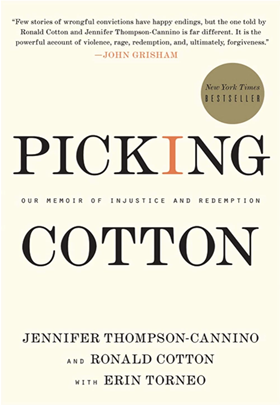
Picking Cotton
Jennifer Thompson-Cannino & Ronald Cotton (with Erin Torneo)
★★★★
In Picking Cotton, the courtroom is not the climax — it is the origin story. Co-authored by Jennifer Thompson-Cannino, a rape survivor, and Ronald Cotton, the man she mistakenly identified as her attacker, this dual narrative dismantles many of the assumptions we hold about memory, certainty and justice itself. The story begins in 1984, when Jennifer was raped in her North Carolina home. Determined to remember her attacker, she studied his face carefully and later identified Ronald Cotton in a police lineup. Her testimony was calm. Her certainty was unwavering. And it was wrong.
Cotton was convicted and sentenced to life plus 50 years. There was no definitive physical evidence linking him to the crime — only a confident witness and a system willing to equate certainty with accuracy. More than a decade later, DNA testing confirmed that another man, Bobby Poole, had committed the assault. Cotton was innocent. The system — and Jennifer’s memory — had failed them both.
A case re-examined, not re-litigated
What makes Picking Cotton extraordinary is not the exoneration itself, but the reckoning that follows it. Jennifer and Ronald write in alternating chapters, tracing not only the legal process but the emotional terrain that comes after catastrophic error: shame, grief, anger, forgiveness and the difficult reconstruction of identity. This is not a revenge story, nor a simplistic redemption narrative. It is something far rarer — an account of mutual repair. For practitioners, the book is a sobering examination of eyewitness testimony and the dangers of overreliance on confidence as a marker of truth. It also highlights what transcripts often fail to capture: the complexity of trauma, the influence of race, and the subtle psychological mechanisms that can distort memory while leaving sincerity intact.
Memory on trial
Perhaps the book’s greatest discomfort lies in how effectively it forces readers to question their own faith in memory. Lawyers and judges know, intellectually, that a witness can be both credible and mistaken. Picking Cotton transforms that abstract principle into something deeply human. The book demonstrates how trauma can sharpen fragments of experience while simultaneously distorting identification and recall. Systems built around certainty can therefore become vulnerable to error not because people are dishonest, but because human memory itself is imperfect.
A rare alliance
In a legal culture built around adversarial positioning, Jennifer and Ronald ultimately chose something different: dialogue over hostility, understanding over permanent division. Their story has since informed judicial training, wrongful conviction advocacy, and broader public discussions about eyewitness evidence. Yet the power of Picking Cotton lies in its restraint. It never demands outrage from the reader. Instead, it quietly exposes how devastating honest mistakes can become once they are filtered through systems that reward certainty and finality. Measured, humane, and impossible to read without reflection, Picking Cotton challenges us not merely to reconsider the courtroom, but to reconsider the assumptions we bring into it.
Rebecca Ward MBA is director of Barristers’ Health (mental health and strategy for the legal profession)









No comments yet