























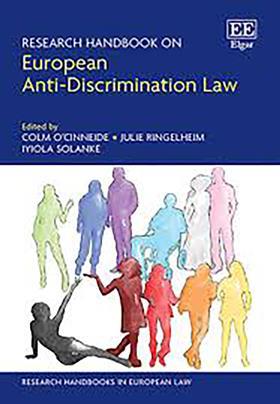
Research Handbook on European Anti-Discrimination Law
Editors: Colm O’ Cinneide, Julie Ringelheim and Iyiola Solanke
£240, Edward Elgar Publishing
★★★★✩
Ten years after the Brexit referendum, does European law have any utility for a UK-based practitioner or academic? Some sceptics might dismiss this handbook as a mere historical footnote in the brave new post-Brexit world. They would be wrong to do so, for two reasons.
First, I would invite sceptics to read the Supreme Court decision Augustine v Data Cars Limited [2026] UKSC 30. At issue was the causation of a detriment suffered by a part-time worker. The court held that the part-time status of the worker need only be an effective cause, but not the sole cause, of the detriment suffered. Lady Simler expended nearly 20 pages of analysis on European materials, including decisions of the ECJ and the travaux préparatoires that had led to the EU’s Framework Agreement and part-time workers directive. A deep understanding of European Law should still be considered an essential part of the practitioner’s armoury.
The second point is subtler. The 20th century saw a debate in the media and in the courts, with regard to the proper scope of the law when it came to social issues.
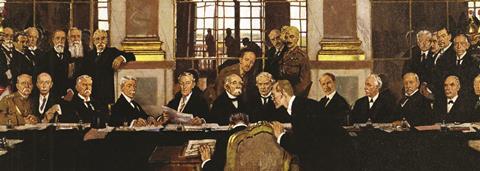
With the Versailles Treaty (pictured), a staggering 35 million people became members of minorities in their countries of residence. In return for recognition of their nationhood, newly created nations had to accept limits to their sovereignty through minority treaties. Nationality and ethnic origins became a basis of rights, albeit imperfectly. While history has not judged the first world war settlement favourably, the idea that there should be limits to national sovereignty would, of course, become more fully realised after the second world war. Nations became pragmatically open to the idea of international standards.
Sex too played a role in getting supranational rules accepted. We can all remember Roberts v Hopwood [1925] AC 578, if only for the gall with which Lord Atkinson in the House of Lords rejected the very idea that the law could countenance ‘feminist ambition’ in its treatment of pay between the sexes. That case is an exemplar of the innate conservatism of the common law, and its reluctance to see rights as something detached from property.
The idea of sex equality had been entertained by the drafters of the Versailles Treaty but was rejected. The mistakes made in the treaty were, fortunately, not repeated after the second world war. International trade under the rule of law was promoted in the Treaty of Rome as a means of finally ending European conflict. This time equality of terms – equal pay between men and women – was incorporated into the drafting.
An experiment was about to begin, and one that continues, even without the UK being in the EU. That experiment gives an insight into how effectively social rights can be incorporated into the laws of nations with different histories and traditions, not least the distinction between common and civil law legal systems. Even if we were not still bound by the elements of European law – frozen into our jurisprudence through the Retained EU Law (Revocation and Reform) Act 2023 – the shared attempt by European nations to create social justice still make this handbook engrossing reading.
The basic idea behind this handbook is to take a snapshot – albeit a pretty intricate one – of an aspect of European law. This work is divided into five broad topic areas and then further splits into chapters with contributions from a range of experts. Academics predominate; the only practitioner in the work is Karon Monaghan KC writing on harassment.
Part I provides a very helpful overview of the sources of European discrimination law. Part II has an equally helpful resume of the basic concepts, including direct and indirect discrimination. European law on anti-discriminatory practices is not just EU law. While the latter has been fixed in our domestic jurisprudence through the Equality Act, how the courts translate ideas into action requires knowledge of another area of European law. This encompasses the Strasbourg rulings of the European Court of Human Rights from which concepts of proportionality have been injected into discrimination law. For example, in Higgs v Farmor’s School [2025] EWCA Civ 109, the court approved the reading down of the Equality Act 2010 under section 3 of the Human Rights Act 1998.This gave effect to the claimant’s rights to manifest her religious beliefs, applying a proportionality test to the manner in which those beliefs had been set out in a Facebook post.
Part IV of the work covers institutions and remedies. Perhaps an opportunity was missed here in not just looking at the mechanics of enforcement bodies but also at the reality of what equality disputes can achieve in reality. It would be good to hear from voices at the at the sharp end of discrimination litigation – trade unions, local authorities and class action equal pay litigators.
I was pleased to see difficult areas receiving appropriate attention, including intersectional discrimination. Kimberle Crenshaw naturally gets suitable prominence: it was Prof Crenshaw who more of less created the concept in her 1989 essay Demarginalizing the Intersections of Race and Sex. I found Prof Iyiola Solanke’s chapter reviewing intersectionality interesting.
When it comes to protected characteristics, it is in the debate over the binary or non-binary nature of gender where flames of controversy have burnt brightest. The chapter on gender identity seems to accept gender as a social construct. I would have liked some consideration of the ‘biological’ arguments defining sex as binary, but this work may have predated For Women Scotland v Scottish Ministers [2025] UKSC 16.
This work is dedicated to Dr Kimberly Liu, a graduate of Harvard, the LSE and UCL and who more latterly taught at Durham Law School. Her death robbed academic law of a great scholar.
Max D Winthrop is a partner at Sintons LLP in Newcastle









No comments yet