























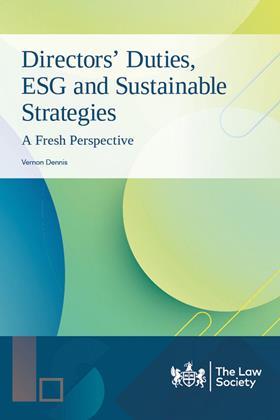
Directors’ Duties, ESG and Sustainable Strategies
Vernon Dennis
£130, The Law Society
★★★★✩
Environmental, social and governance considerations are increasingly prominent aspects of corporate decision-making. As regulatory expectations evolve and stakeholders demand greater accountability, directors are expected to navigate a complex landscape that extends beyond traditional measures of corporate success. Vernon Dennis examines how these developments intersect with the legal obligations of company directors, providing a thoughtful contribution to an area of growing importance.
One of the book’s principal strengths lies in its ability to connect legal doctrine with commercial practice. Rather than presenting ESG as a separate or competing framework, the author positions it within the established principles governing directors’ duties. Sustainability considerations need not be viewed as distinct from directors’ legal responsibilities. Long-term value creation, stakeholder interests and sustainable business practices can be accommodated within existing governance structures.
The opening chapters provide an overview of the foundations of directors’ duties and the development of modern corporate governance. This contextual grounding allows a discussion of ESG-related issues to unfold in a clear and coherent manner. The analysis is detailed yet accessible, making the text suitable for a broad readership.
Particularly noteworthy is the examination of section 172 of the Companies Act 2006. Dennis explores the requirement for directors to promote the success of the company while taking account of wider stakeholder interests. This provision is often the subject of debate and differing interpretations, but the author succeeds in explaining both its legal significance and its practical implications. Contemporary governance increasingly requires directors to consider the long-term impact of corporate decisions.
At times the discussion does become repetitive, particularly where stakeholder interests and long-term value creation are revisited from different perspectives. While these are central to the book’s argument, it lacks a more detailed examination of recent litigation and enforcement trends to illustrate how these principles are tested in practice.
The treatment of ESG is balanced and measured. Dennis avoids advocacy in favour of careful analysis. The text acknowledges the opportunities that effective ESG strategies may create while recognising the challenges organisations encounter when implementing them. This even-handed approach enhances the book’s credibility and practical value.
The chapters dedicated to strategy are among the most compelling. Rather than focusing on compliance and risk management, Dennis considers how sustainability objectives can be incorporated into broader corporate planning. Practical examples and observations help illustrate how governance frameworks can support sustainable decision-making without losing sight of commercial realities. These sections will be of particular interest to those advising boards or involved in organisational leadership.
The prose is refreshingly direct for a subject that often attracts dense academic treatment. Complex legal and governance concepts are explained with precision, while the structure allows readers to move easily between doctrinal analysis, regulatory developments and strategic considerations. The extensive references further strengthen the book.
Dennis has produced an accessible guide to an area that continues to evolve. While some sections could have benefited from a greater focus on practical case studies, the book succeeds in explaining how sustainability considerations fit within the existing framework of directors’ duties.
Zainab Zaeem is director/solicitor at Summerfield Browne Solicitors, Leicester








No comments yet