






















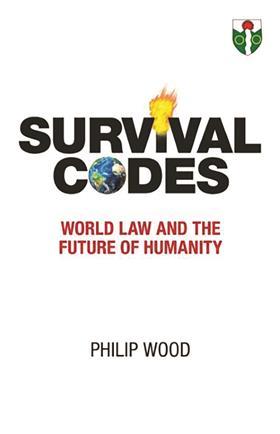
Survival Codes: World Law and the Future of Humanity
Philip Wood
£35, Softwood Books
★★★★✩
This is a book of two halves. The first is excellent; the second is a different book altogether, about which I have questions. The whole is enveloped in an overarching philosophy with which you might not agree – I do not agree with it – but which will provoke you (it has already provided the basis of a pleasurable argument between me and a close friend).
The author is the distinguished and well-known solicitor Philip Wood, a former partner at Allen & Overy, academic, and author of books on the law and practice of international finance.
To start with, the overarching philosophy. Its ambitions are outlined in the book’s opening section: ‘The fact that our laws, as our codes of conduct, are now the most all-encompassing moral ideology which we have and which transcends all others is a platitude, a self-evident truth, a truism so obvious that it must amaze us that so few seem to have grasped this.’
He describes the law as larger in scope than all other philosophies, such as politics, science, knowledge or ethics. He says the law is a general universal philosophy.
Well, I do not agree, even after reading the book. The author has to describe its obviousness three times (‘a platitude, a self-evident truth, a truism’). I cannot be alone in never thinking about the law as I make my daily and weekly moral choices. The law does not deal with most of them anyway, such as whether and how I give to charity or care for my loved ones (apart from in extreme cases, which barely touch most people’s lives). I suppose it all comes down to definitions.
But it does not matter whether you agree with the author’s philosophy, because it is a provoking thought, and well worth proposing, even if to disagree with.
In the first half of the book, Wood describes the nature and history of law. I wanted more of this. For instance, he describes – with clear accompanying maps – how the world of 320 or so legal jurisdictions (not the same number as countries) is now dominated by just three major families of law: common law (England and US), making up roughly 40%; Napoleonic (30%); and Roman-Germanic (20%). The remaining 10% are a mix of others, such as Islamic sharia law. How this came about is fascinating, as is his submission that English law is England’s greatest export, even greater than the English language – doubtless true in economic terms, if not in terms of soft power.
He compares the Roman and British empires, both with long-lasting legacies of law and language, and says that they have both, to a greater or lesser degree, influenced nearly all the world’s legal systems. What an achievement!
The second half of the book, larger in terms of number of pages, is devoted to what he calls the 12 domains of law. He breaks them down into: constitutions, taxation, crime, regulation, family, contracts, torts, property, corporations, bankruptcy, conflict of laws and public international law. Their global content is briefly summarised, and they are assessed against, first, morality, justice and efficiency and, second, whether violations create significant misery.
He is an international finance lawyer. I, in my ignorance, would have put commercial law into fewer domains. On the other hand, the sections on contracts, property, corporations and bankruptcy are illuminating (securitisations and derivatives clearly explained). He gives an overall rating of 60% against his criteria of justice and human consequences, the score being dragged down by constitutions and public international law.
My problem with this second half is that the substantive content is no longer needed in the age of AI and the internet. It contains surveys of the state of the law around the world in all 12 domains. True, the comparative side may not be so easy to Google, although ChatGPT may give you a shaky version of it. But who wants a survey of, say, the state of anti-discrimination law around the world? For a specialist – a lawyer or a student – the sweep in the book is too brief to be helpful. For a general reader, it is too much when combined with a survey of every other area of law. Moreover, it will have gone out of date the week after it was published and lose more value as time passes.
It is not often that a book provokes so much thought, even where one disagrees (for instance, the author loves recent ‘culture war’ examples to highlight his text, with interpretations which sometimes caused me to sigh). In that sense, both halves of the book are a great success.
If I were to advise him, though, I would say to take the first half, expand it and he would have a bestseller on his hands.
Jonathan Goldsmith is Law Society Council member for EU & International







No comments yet