























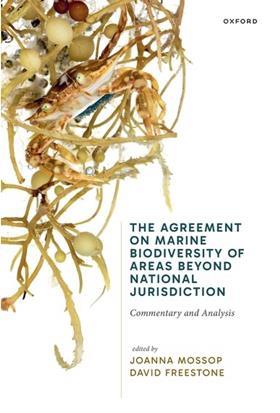
The Agreement of Marine Biodiversity of Areas Beyond National Jurisdiction
Edited by Joanna Mossop and David Freestone
£160.00, Oxford University Press
★★★★★
This volume provides an exhaustive legal analysis of the BBNJ, a complex treaty which governs activities in the High Seas and the deep seabed beyond national jurisdiction, areas traditionally characterised by legal ambiguity and regulatory gaps. By bringing together leading experts who were directly involved in the negotiations, the book offers readers a rare insight into both the intricate drafting process and the legal reasoning underlying the final text.
The work excels in its comprehensive treatment of the BBNJ Agreement. It situates the treaty firmly within the framework of the United Nations Convention on the Law of the Sea (UNCLOS), clarifying how it complements, extends, and interacts with existing international legal instruments. Mossop and Freestone provide a meticulous article-by-article commentary, addressing core provisions such as marine genetic resources, benefit-sharing mechanisms, area-based management tools, environmental impact assessments, and capacity-building and technology transfer obligations. Each commentary balances detailed legal analysis with practical considerations, highlighting potential areas of ambiguity and foreseeable challenges for states and other stakeholders in implementation.
Particularly noteworthy is the authors’ treatment of institutional and governance arrangements. The BBNJ Agreement introduces mechanisms for coordination between states, international organisations, and existing sectoral bodies, which is a complex legal landscape that demands careful navigation. The book critically examines these arrangements, identifying both opportunities for enhanced cooperation and potential sources of legal and operational friction. Furthermore, the discussion of dispute resolution mechanisms, compliance, and monitoring illustrates how the treaty seeks to balance sovereignty concerns with global conservation objectives.
Mossop and Freestone also provide valuable insight into the negotiation dynamics and policy compromises that shaped the final text. This perspective is essential for understanding the interpretive debates likely to arise in legal and political contexts, particularly around the management of marine genetic resources, equitable sharing of benefits, and the definition of environmentally significant areas beyond national jurisdiction. By marrying doctrinal analysis with negotiation context, the book ensures that readers gain not only a legal understanding of the BBNJ Agreement but also a strategic perspective on its implementation.
For practitioners, this volume is indispensable. As states, corporations, and non-governmental organisations increasingly engage in activities in areas beyond national jurisdiction, the BBNJ Agreement will define the legal framework for conservation, sustainable use, and governance of marine biodiversity. Understanding the intricacies of its provisions, the potential for legal disputes, and the operational complexities of intergovernmental coordination is crucial for advising clients or governments on compliance, risk management, and strategic engagement. Mossop and Freestone provide a rigorous, authoritative, and accessible resource that equips legal professionals to navigate the doctrinal, procedural, and policychallenges posed by this transformative treaty, making it essential reading for anyone engaged in international maritime law and marine environmental governance.
Simone Mamini is a doctoral researcher in law and a visiting lecturer in maritime and international law at City St George’s, University of London









No comments yet