







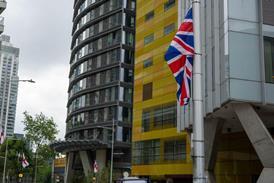














International Law and Architecture
Editors: Renske Vos, Sofia Stolk, Miriam Bak McKenna
£135, Edward Elgar Publishing
★★★★★
This is a fantastic work of intellectual curiosity, absorbing in its efforts to link the tenements of international law to its tenets.
The idea for the book emerges from a juxtaposition of the sleek lines of the modern law school building and the neo-Gothic ornament of the Peace Palace in The Hague, home of the International Court of Justice and the Permanent Court of Arbitration. What might come out of exploration of the differing emotional and tangible impacts of the design of the structures housing international law?
The various essays are situated in the wider academic landscape and debate – the theoretical underpinnings of international law, revealed through its publications; the possible collapse of an international rule-based system with renewed focus on localised concerns; visuals used by international legal bodies to promote their aims. Taken together, the generative drive behind the project becomes clear: discussion of the artifacts, space and aesthetics of international law is, in effect, a description of ‘architecture’ – the art and design of structures.

The editors use the analogy of a construction project in the book’s ordering and, while an almost irresistible conceit, it is rather on the nose. Still, it provides a workable structure, with essays seeking to review the foundations of international law, before moving on to its constructs and physical spaces.
To pick an example, one chapter investigates the green spaces annexed to courthouses and their international, imported perspective as a manifestation of colonialism. The idea of the garden is extended to become a metaphor for an idealised international legal order: a community garden acting as a non-hierarchical collaborative space.
Another paper explores the architecture of NATO headquarters over the years, from its first strategic HQ in Paris to its various homes in Brussels, ultimately arguing that its purpose-built base in Boulevard Léopold III lacks something vital. An anonymous, glass-fronted ‘commercial property’ is a missed opportunity to communicate values – reflecting, it is suggested, doubt or ambivalence about NATO’s role in the world. Topical, given the current challenges to a rules-based system.
This book is an unashamedly interdisciplinary work for an academic audience. Yet it remains accessible to anyone seeking different ways of understanding the international legal order, its history, development and, critically, its future.
Tom Proverbs-Garbett is a director of TrustPoint Governance and author of Being a Trainee Solicitor: How to Survive and Thrive







No comments yet