




















UK Sanctions Law and Practice
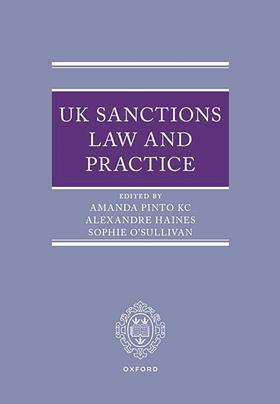
Amanda Pinto KC, Alexandre Haines, Sophie O’Sullivan
£125, Oxford University Press
★★★★★
The consequences of sanctions can be far-ranging and have unexpected consequences. Consider president Trump’s statement: ‘I, Donald J Trump, president of the United States of America, find that the International Criminal Court (ICC, pictured), as established by the Rome Statute, has engaged in illegitimate and baseless actions targeting America and our close ally Israel... The United States will impose tangible and significant consequences on those responsible for the ICC’s transgression, some of which may include the blocking of property and assets, as well as the suspension of entry into the United States of ICC officials, employees and agents, as well as their immediate family members, as their entry into our nation would be detrimental to the interest of the United States.’
To date, 11 of the ICC’s officials, including the chief prosecutor and nine judges, have been placed under US sanctions, subjecting them to measures that include bans on travel to the US and fines and prison sentences for US companies which provide them with services. Those subject to sanctions are prevented from booking an Uber, reserving certain flights, booking hotel rooms on many websites, making bank transfers or even using Amazon and Google accounts. Sanctions trickle down to family members of those individuals named by the White House who have no link to the ICC. Even spouses, parents and children of officials have ended up being unable to use Apple ID, iCloud, Amazon, Airbnb and PayPal.
In my own professional experience, having advised clients on numerous sanctions issues in recent years, it is, to all intents and purposes, futile to try to contact the Office of Foreign Assets Control (OFAC) – the US government’s sanctions authority. OFAC invariably does not respond to any communications it receives. Accordingly, individuals who have been sanctioned for no justifiable reason are unable to plead their case and explain why sanctions that have been imposed on them should be lifted. Quite apart from the OFAC sanctions imposed on the judges and chief prosecutor of the ICC, I am aware of OFAC sanctions being imposed on individual lawyers in various European countries. As a result, they are unable to run their practices, operate bank accounts, or even make provision for their children, who also, in turn, are unable to operate bank accounts as a result of US sanctions.
This book provides eloquent and succinct guidance on various aspects of sanctions law. Since Brexit, UK sanctions law has undergone a significant transformation. The authors address not just UK-related issues but also global challenges. They analyse the current UK sanctions framework, particularly the scope of the Sanctions and Anti-Money Laundering Act 2018 (SAMLA). It focuses on the complex Russia Regulations and also considers financial, trade, transport and human rights sanctions. It clarifies the sanctions regime and analyses key Court of Appeal and Supreme Court cases, including the leading cases of Shvidler and Dalston Projects. It also offers an insight into statutory provisions and government guidance.
Lady Rose of Colmworth writes in the foreword: ‘Looking at the world around us, it seems clear that sanctions will continue to be needed to help keep the citizens of this country safe and to ensure that the United Kingdom plays its part in shaping world events. The authors of this book have created an invaluable resource for current and future practitioners in this fast-moving area.’
Perhaps one of the most interesting and overlooked sections in the UK Russia (Sanctions) (EU Exit) (Amendment) (No. 14) Regulations 2022 is regulation 58(5) which states: ‘The prohibitions in regulations 12 and 13 are not contravened by the transfer of funds to a relevant institution for crediting to an account held or controlled (directly or indirectly ) by a designated person, where those funds are transferred in discharge (or partial discharge) of an obligation which arose before the date on which the person became a designated person.’
This provision was recently discussed in Chanana v Khan [2025] EWHC 1472 (Ch), where one party sought to set aside a statutory demand for unpaid rent on the basis that the landlady was a designated person. The landlady argued that the applicant’s liability to pay rent had arisen pursuant to the lease agreement, which was entered into pre-designation, thus engaging the exception under regulation 58(5). The High Court concluded that the exception was wide enough to apply, mainly because that was the effect of the equivalent provision under EU law, and there was no reason to consider that it was intended to have a narrower scope under UK law post-Brexit: ‘Both were essentially intended to allow for payments in discharge of obligations the source of which pre-dated designation.’
The bulk of UK sanctions legislation relates to Russia. However, North Korea, Myanmar, Afghanistan, the Central African Republic, the Democratic Republic of the Congo, Haiti, Iraq, Iran, Lebanon, Libya, Mali and Belarus are also subject to various sanctions in the UK and elsewhere.
It goes without saying that sanctions law is inextricably linked to international politics and inevitably involves public international law, commercial law, human rights law and criminal law. For example, at the end of last year the UK designated Russia’s two largest oil companies, PJSC Rosneft and PJSC Lukoil. Rosneft alone produces nearly half of Russia’s oil.
There is considerable overlap between UN and EU sanctions because the EU adopts measures to implement all sanctions imposed by Security Council resolutions, the latter having direct legal effect on all EU member states, which included the UK before Brexit. The EU can also impose its own sanctions. In addition to UN and EU sanctions, the Organization for Security and Co-operation in Europe, of which the UK is a member, can also impose sanctions.
Post-Brexit, the UK continues to be bound by international law, but it is no longer bound by European law and EU instruments. The UN sanctions now have to be implemented directly by the UK under SAMLA.
This book discusses the Magnitsky elements of sanctions law. The Criminal Finances Act 2017 amended the Proceeds of Crime Act 2002 to expand the definition of ‘unlawful conduct’ to include gross human rights abuse or violation. SAMLA includes gross human rights violations as a reason for imposing sanctions on a person or an entity. The UK government announced the first new Magnitsky sanctions in July 2022 under the Global Human Rights Sanctions Regulations 2020; 25 Russian officials allegedly involved in the mistreatment of tax auditor Sergei Magnitsky have also been targeted.
The UK imposed asset freezes and travel bans on 20 Saudi citizens alleged to have been involved in the murder of Jamal Khashoggi, the Saudi journalist murdered in the Saudi Consulate in Istanbul.
Of course, Russia’s invasion of Ukraine in February 2022, which escalated the Russo-Ukrainian conflict that started in 2014, has had an enormous impact on UK sanctions law. This book helpfully emphasises economic sanctions, including financial and trade sanctions. It does not deal with all types of sanctions, including, for example, immigration sanctions. Its focus is on the UK’s Russia Regulations. It would be wise not to fall foul of those regulations. Practitioners will no doubt be aware of the £465,000 penalty imposed on Herbert Smith Freehills by the Office of Financial Sanctions Implementation (the UK regulatory body) for breaches of UK financial sanctions on Russia.
I conclude this review with a reference to contemporary events. The Trump administration has attempted to exert maximum pressure against Iran in recent months, involving the aggressive use of sanctions. Iran’s continuing support for Israel’s enemies and its general role from a US perspective as a destabilising force in the Middle East will no doubt result in broader and more aggressive sanctions which will affect us all.
Stephen D Sutton is principal of Suttons Solicitors and International Lawyers, London







No comments yet