























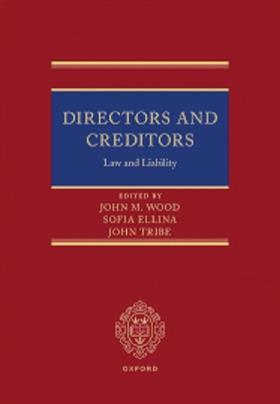
Directors and Creditors: Law and Liability
Editors: John M Wood, Sofia Ellina, John Tribe
£195, Oxford University Press
★★★★★
Few recent decisions have attracted as much attention as BTI 2014 LLC v Sequana SA, which clarified when directors must take creditors’ interests into account, confirming that this duty arises when a company is insolvent, bordering on insolvency, or when insolvency has become probable. It is therefore no surprise that Directors and Creditors: Law and Liability uses the judgment as the foundation for its discussion of directors’ duties and creditor protection. As the introduction explains, this is far more than a commentary on Sequana. Rather, it uses the judgment as a springboard to examine the broader and increasingly complex relationship between directors’ duties, creditor protection and corporate governance.
The introduction recognises that directors today must balance competing obligations owed not only to shareholders, but also to creditors, regulators and other stakeholders. Against a backdrop of economic uncertainty, restructuring, environmental responsibility and evolving governance expectations, the editors identify the growing tension between entrepreneurial decision-making and creditor protection as one of the defining challenges facing modern company law.
What distinguishes this work is the breadth of its ambition. Rather than focusing solely on creditor duty, the editors bring together a range of contributors to explore wider issues, including fiduciary duties, directors’ personal liability, wrongful and fraudulent trading, corporate sustainability and environmental liability. The objective is not simply to explain the law as it currently stands, but to consider how it has developed, where uncertainties remain and how it may continue to evolve.
The editors seek to bridge legal theory and commercial reality, providing both conceptual analysis and practical context. This approach is likely to prove valuable to those advising companies facing financial distress, as well as those with an academic interest in corporate governance.
Given the subject matter, this is not intended as an introductory text. It is clearly aimed at practitioners, academics and those specialising in company and insolvency law who require a detailed examination of the legal principles and policy considerations that underpin directors’ duties to creditors. Despite its practical relevance, this is not a handbook designed for quick reference. It is a substantial reference work, best consulted chapter by chapter rather than a cover-to-cover read.
That said, its technical nature is also one of its strengths. The editors acknowledge that Sequana answered some important questions while leaving many others unresolved. By examining those unanswered questions within the wider framework of company and insolvency law, this collection arrives at an appropriate time and reflects the continuing development of directors’ duties in an increasingly challenging commercial environment.
Zainab Zaeem





No comments yet