























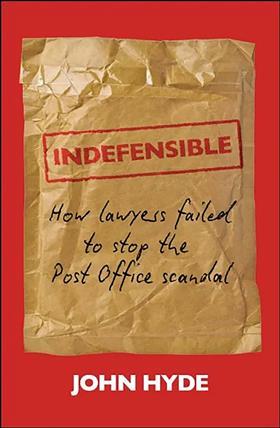
Indefensible: How Lawyers Failed to Stop the Post Office Scandal
John Hyde
£14.99, Bristol University Press
★★★★★
Identified by the Criminal Cases Review Commission as ‘the most widespread miscarriage of justice’ it had ever seen, the Post Office Horizon scandal has to date been most commonly analysed from the perspective of catastrophic failures in technology and governance. This book, however, focuses on the role played by lawyers at each stage of the unfolding scandal, and asks what their actions reveal about the realities of professional independence and accountability in a modern legal profession.
John Hyde, deputy news editor of the Law Society Gazette, has been reporting on lawyers, their professional standards, and the consequences of non-compliance, for over 15 years. He has extensive experience of his subject matter, despite not being a lawyer himself.
Unlike most prior media coverage, this book is devoid of any hint of sensationalism. Instead, its analysis and resulting concerns arise from a considered examination of the evidence produced during the extensive statutory inquiry hearings.
A key concern identified is whether the legal profession has been, and continues to be, sufficiently vigilant in upholding its core standards when those standards conflict with institutional pressures, client interests and the commercial realities of running a law firm.
Those subject to most scrutiny are the lawyers involved in the criminal prosecutions and civil actions brought against the sub-postmasters. The focus is on their handling of disclosure and expert evidence, alongside their failure to reassess earlier convictions and judgments, as doubts began to emerge about the Horizon system itself (doubts that arose at an alarmingly early stage). The question asked is whether the legal reasoning employed was too heavily influenced by the Post Office’s interest in upholding the reputation of a once-respected public institution.
This question is asked equally of both the Post Office’s own in-house team and the various external lawyers instructed on Horizon-related matters. In the case of the former, the realities of being subject to the obligations of a regulated independent professional while being employed by an organisation which does not share those obligations (and may not be prepared to listen to any advice provided) are considered in some detail. In the case of external lawyers, the book examines litigation strategy, disclosure and the use (and potential for abuse) of legal professional privilege. Without strict adherence to core professional principles, some legal mechanisms have the potential to limit both transparency and accountability.
Later chapters analyse more general issues around the systems and culture that support and enforce professional standards, leaving the reader to form their own view as to whether the current English legal system as a whole can truly be said to be fit for purpose.
What makes this book as unsettling as it is compelling is that, while the facts behind the Horizon scandal may be unique, the professional dilemmas it exposes are anything but.
Sean Gordon is a risk and compliance solicitor, and former compliance officer for legal practice and data protection officer
Indefensible: How Lawyers Failed to Stop the Post Office Scandal
★★★★★
Before reading Indefensible, I thought: ‘How would John Hyde from the Gazette feel writing about lawyers involved in the Post Office scandal? Will he feel protective of those he usually writes for? Would he be able to tell the truth when his paymasters are (effectively) those very lawyers?’ I ought not to have worried. Hyde displays the quintessential qualities of journalism in his incredible book. According to AI sources, these qualities are: curiosity and inquisitiveness, mastery of communication, accuracy and attention to detail, scepticism and critical thinking, objectivity and ethics, and persistence and tenacity.
Many of these characteristics ought to be shared by we solicitors. But reading this book, you will see that they are sadly lacking in many of those involved in the PO scandal. I can only agree with Hyde – it cannot just be a few ‘bad apples’.
The author manages to honour his professionalism and neutrality, so it’s not a salacious read when, really, it could have been.
Hyde saves you the trouble of listening to or watching the full inquiry, or reading the many other sources that go into this sorry story. He evidences each point made with an enviable index and pages of citations. There is also a list of key characters – given how many are involved, this is extremely helpful. The chapters are short and highly readable. Factual, yet pacy and interesting. A detailed dissection of various cases enables the reader to see the situation in a personal way; not just sweeping statements about what happened.
There are shocking revelations:
- That the person in charge of criminal prosecutions was a conveyancer, with little or no experience or training in the rules and art of criminal law work.
- That lawyer after lawyer failed to carry out proper disclosure.
- Extending and abusing legal privilege in an attempt to circumvent disclosure rules.
- Double-downing on keeping the truth to themselves. The lawyers, far from being neutral, sided with the corporation’s wants and needs (sometimes acting more like PR folk) rather than abiding by their ethical and administration of justice duties.
- Hyde is rightly bemused by the lack of curiosity of successive lawyers.
- Only a handful of lawyers thought, ‘this isn’t right’.
- Lawyers did not instruct an expert on their duties and responsibilities.
- Running cases to ‘ruin’ defendants.
- At board level, a wanton lack of inquisitiveness.
- The lack of equality of arms with little or no legal aid.
- The idea that ‘computer knows best’ – that the courts routinely believed Horizon.
And the list goes on. As Hyde says: ‘The unquestioning devotion to a client, the lack of supervision (especially in-house), the commercial pressures to say what clients want to hear, the temptation to act aggressively in adversarial litigation’ are behaviours we can ‘all recognise’. As he asks, ‘What would you do?’ As he tells us, with a third of lawyers employed in-house, this is a clarion call to all of them.
I had naively wondered why the Solicitors Regulation Authority asks the question in our practising certificate renewal about the percentage of work obtained from single clients. Perhaps if this had been asked in the early days of this scandal, the external lawyers would have had to answer queries about their independence (over half their work came from the Post Office). We can only hope that the SRA will now scrutinise firms whose work is dominated by just a few clients. This may be one of the many lessons we can learn from Hyde’s book.
As Hyde asks us to do, we must reset the ethical limits of our profession and re-examine the regulatory and supervisory balance to ensure that we are not complicit in future scandals.
There are too many wise words in the book to choose from here. So, do yourselves a favour and read it.
Jo O’Sullivan is an accredited mediator, solicitor neutral, author of (Almost) Anything But Family Court and founder of O’Sullivan Family Law








1 Reader's comment