























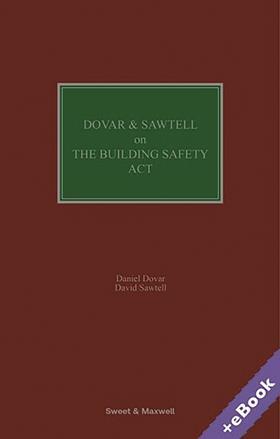
Dovar & Sawtell on the Building Safety Act
Daniel Dovar and David Sawtell
£195, Sweet & Maxwell
★★★★★
The Building Safety Act 2022 has generated no shortage of commentary since its enactment. Yet much of it has fallen into one of two camps: either introductory guides aimed at general practitioners, or highly specialised articles addressing individual aspects of the legislation. This book attempts something considerably more ambitious. It seeks to provide a comprehensive treatment of one of the most complex pieces of legislation to reach the statute book in recent decades. It succeeds, though readers should be under no illusion that this is an easy companion.
This is a serious work written by serious practitioners. The contributors, drawn from Tanfield Chambers and 39 Essex Chambers, bring obvious expertise in construction, public law and property litigation. That depth of experience is evident throughout. Rather than merely describing what the legislation says, the book explains how the various statutory provisions fit together, where uncertainties remain and, importantly, where future litigation is likely to shape the law.
The Building Safety Act itself is notoriously difficult to navigate. It is not a self-contained code but a legislative framework surrounded by a vast ecosystem of regulations, amendments to earlier legislation and evolving guidance. One of the principal achievements of this book is that it manages to impose a coherent structure upon that complexity. The early chapters provide valuable historical context, tracing the development of building regulation from the 17th century through to Grenfell, Dame Judith Hackitt’s review and the legislative response. That background is more than scene-setting; it helps explain why the legislation takes the form that it does.
The text’s strength lies in its methodical analysis. Chapters on the new Building Safety Regulator, higher-risk buildings, accountable persons, gateway procedures and enforcement powers are carefully organised and heavily referenced. The authors clearly expect the reader to move between the act, subordinate legislation and case law simultaneously, and the cross-referencing throughout is generally excellent.
Particularly impressive is the treatment of the regulatory regime itself. Rather than presenting the legislation as a collection of isolated provisions, the authors explain how approval procedures, completion certificates, compliance notices and enforcement mechanisms interact in practice. For practitioners advising developers, landlords, managing agents or leaseholders, this integrated approach is extremely valuable.
The book is equally strong in recognising that much of this area remains unsettled. The authors are appropriately cautious where appellate authority has yet to emerge, distinguishing between settled law, developing principles and informed opinion. That intellectual honesty enhances the work’s authority. Too many legal texts attempt to state conclusions where none yet exist; this volume is refreshingly measured.
If there is a criticism, it is one that inevitably accompanies works of this depth. This is not a book that rewards casual reading. At times, the density of the material becomes formidable. Paragraphs frequently contain multiple statutory references, regulations and cross-citations which demand careful concentration. Even experienced property lawyers may find themselves reading certain sections twice before the overall structure becomes clear.
That density is not a flaw so much as a consequence of the subject matter. The Building Safety Act is itself exceptionally dense legislation. Any commentary that genuinely attempts to explain it comprehensively cannot realistically be light reading. Readers looking for practical checklists or simplified summaries may therefore find themselves overwhelmed. This is a reference work first and foremost.
Production quality is excellent. The typography is clear, the layout sensible and the indexing appears comprehensive. For a practitioner returning repeatedly to particular topics rather than reading cover to cover, these features become more important than might initially be appreciated.
Perhaps the book’s greatest achievement is that it inspires confidence. One finishes with the impression that, however difficult the legislation may be, there is a logical framework underpinning it, and that framework has been carefully mapped by the authors.
While this book is demanding, detailed and unapologetically technical, those qualities are precisely what make it valuable. The authors have produced an authoritative guide to legislation that will shape property and construction law for many years.
Anna Newport is a solicitor and director at Newport Land and Law Ltd, Wakefield









No comments yet