






















Law in the Era of AI: Clients, Firms, and the Future of the Legal Industry
Bjarne P. Tellmann
£32, Wiley
★★★★★
AI will destroy the world, AI will take your job, AI will even drink your coffee – it seems that the AI hype knows no boundaries. Amid the white noise, it can be very difficult to separate truth from hyperbole.
That is one of the reasons why I like this book. According to his biography, the author Bjarne P Tellmann is a veteran general counsel who has worked for 30 years for major corporations, has a clear grasp of the needs of business and the commercial world, and has set out his thoughts on how AI will affect this world. The focus is commercial; the criminal practitioner wondering how AI will affect her work in Coalville Magistrates’ Court will have to look elsewhere for inspiration.
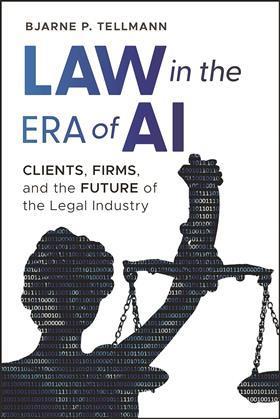
The book is divided into four parts and subdivided into 15 chapters. The first part grounds the book in explaining the role of general counsel and looks at how that role has expanded or evolved over the years from 1945 to 2022. That endpoint is deliberate. It separates the historical period from the inception of AI as a mainstream tool for public use. If, as Philip Larkin famously wrote, sex began in 1963, AI began for most people’s purposes with the release of ChatGPT in 2022.
The second part focuses on the AI era. If AI is doing 90% of your work, what really is the point of you? Well, if that 90% is the mundane or low-value or low-skill work, it is the 10% that will keep you in a job – deploying skill, subtlety and judgement that AI cannot replicate. At least for now.
The third part considers the impact of deploying AI on the traditional law firm model, and predicts, rightly in my view, the death of the billable hour. Large-scale deployment of AI, mapped against traditional time-keeping and billing, will mean the death of firms, as they make themselves lean and efficient to survive. But the author goes further, predicting substantial change to the partner/associate/paralegal pyramid, which loses its utility at the onset of the Fourth Industrial Revolution.
In the final part of the book, the author considers the future. Whatever technology can do, human beings are instinctively conservative and slow to adopt it. Anyone who has been to their GP recently and found they still have to fill in a paper form as part of analogue practice, so that someone else can laboriously type the contents into a PC, will have seen this phenomenon in action.
Stepping back, I found this a thoughtful contribution from someone who has thought deeply about how a transformational technology is going to transform his niche. I particularly enjoyed the third part of the book, and the well-founded analysis of the impact of AI on his sector. One is left with the clear impression that although AI may not drink a lawyer’s coffee anytime soon, it may very well rapidly eat the lunch of conservative law firms, which will not see the oncoming tide of technology and how it affects their business model until it is too late.
Andrew Hogan is a barrister at Hailsham Chambers and the author of Andrew and the Marvellous Analytical Engine, available on Amazon









No comments yet