






















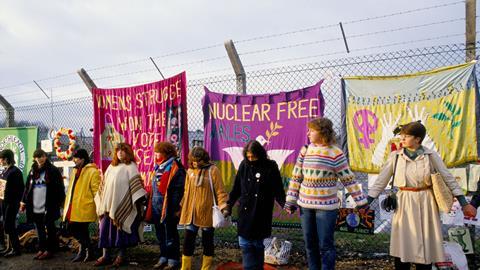
Speaking in 2017 about her experiences at the Greenham Common Women’s Peace camp, feminist activist Di McDonald commented:
'At Greenham, everyone was equal, and everyone had the opportunity to speak or not speak in a meeting, because there were no leaders. We had a saying: "The only stars are in the sky"'.
As the women of Greenham knew, great women – and men – rarely act alone. Ahead, behind and beside every heroine and hero, sits a network of women and men. Women and men who said they could, who inspired, encouraged and supported their rebellious activities and who facilitated and shaped their heroic credentials. If we focus only on the bright stars – whether for censure or praise – we fail to see most of the stars in the sky.
So too in law. As the multitude of women’s professional networks and collaborations demonstrate, we – in which we include women, men who empower women, and those who live outside and resist such binaries – are stronger together.
Mapping the constellations of relationships, networks, connections and so on within which that individual worked and lived has been an important feature of feminist legal history for some time. These feminist constellations create the space to recognise the contribution of women yet, or never to be, ‘found’. They allow us to ‘see’ the working-class women, rural women, illiterate, sisters, mothers, spinsters, children, who have not left behind swatches of rich source material. And to tell the stories of women and feminists on the fringes of these accounts are at risk of being unheard.
After all, only a fraction of stars in the sky are visible to the naked eye, even fewer make up the pattern of a constellation, and some constellations – including dark constellations most visible in the southern sky – have no stars at all. To see them we need to shift our focus away from looking at – or for – stars and toward the darker patches of the sky formed by clouds of gas and which hide the stars within them. It is here in these dark feminist constellations intertwining with, within and alongside their glistening counterparts, collectives of unknown women on whose shoulders we stand. Women who came together for a specific purpose. Women who, for example, marched from Cardiff to Greenham in August 1981, who met at Langham Place in the mid-19th century, who canvassed in Ireland as part of the Repeal the Eighth campaign, the unnamed women who started the Rape Crisis centre in London in November 1974 and those who founded Southhall Black Sisters in the crucible of racism and fascism in late 1979.
It is in these stories that we learn about the group of friends sitting together in an upstairs restaurant in Dublin after days of campaigning, hearing the cheers from the street below, after referendum exit polls from the 2018 referendum overturning a constitutional ban on abortion was announced. About the counsellors at Klinic – a medical and crisis centre based in Winnipeg, Canada – dancing to the pop song ‘Rise Up’ by The Parachute Club – a celebration of LGBT people and women.
These stories allow us to stand alongside the women, feminist and activists who have gone before. They offer practical demonstration of – to adapt Pragna Patel’s words – the extent to which we stand on the shoulders of many women and activists before us who collectively have ‘fought every step of the way for everything that we enjoy today’ – and challenge us to continue to do the same. For after all, when we look to the sky, it is not the few that form the pictures of the constellations or even the brightest stars that first get our attention or capture our imagination, or even the 9,000 or so that we can see with our naked eye, it is the sheer magnitude of 200 billion trillion visible and invisible stars across the universe that takes our breath away.
These and other stories are explored in the new series of Not for Want of Trying, a history podcast exploring the cases, campaigns and legislation that have shaped women's rights in the UK and Ireland. Each week, Sharon Thompson and Erika Rackley talk to leading experts about a key legal landmark, the role women played in bringing it about, and why it still matters today.
Not for Want of Trying is sponsored by Hart Publishing. It is available to listen to and download wherever you get your podcasts.









3 Readers' comments