
























Injuries have risen, yet claims are down. Catherine Baksi considers a growing access-to-justice crisis for people harmed by the errors and negligence of others
The low down
People harmed through the negligence of others have been demonised by politicians, media commentators and the insurance industry. Misinformation and misunderstanding have made personal injury victims ‘second-class citizens’, according to research by a not-for-profit campaign group. Research and polling by the Association of Personal Injury Lawyers trace a pattern of legal aid cuts and other reforms that have made it harder for those injured to seek justice and more difficult for specialist lawyers to help them. The number of injuries is rising, yet claims have fallen dramatically. That reflects a hostile environment for claims. Meanwhile, the law is failing to keep up with emerging problems, notably those harmed by individuals riding e-scooters.
Almost a third of UK adults have at some point been harmed due to someone else’s negligence, but 7.5m of these victims have never sought justice. This is the stark finding of recent opinion polling conducted by the Association of Personal Injury Lawyers (APIL), highlighting the growing difficulties faced by people seeking redress.
APIL’s report, The Justice Gap Facing Victims of Personal Injury, published earlier this month, says that the UK faces a ‘crisis’, with millions of injured victims unable to access the justice and support they need.
The group blames policy decisions made from 2010 onwards that have ‘fundamentally undermined access to justice for injured people’. During this time, the report says, the ‘need to provide full redress to people whose lives are often devastated by needless injury has been overshadowed by a narrative which has focused on the need to protect businesses, safeguard insurance companies’ profit margins and control spiralling insurance premiums’.
In written evidence to the House of Commons justice committee, which published its own access to justice report this month, APIL told MPs: ‘In the world of civil litigation, people injured as a result of negligence have effectively become second-class citizens.
‘Access to justice has been fundamentally undermined by a series of damaging policy decisions, while vitriolic rhetoric about injured people has been based on misinformation and misunderstanding.’
APIL’s submission also stressed the imbalance between vulnerable injured people and those who defend claims, stating that the former ‘tend not to be well-resourced, and are completely unfamiliar with what can be a complex area of law’.
Conversely, it pointed out, ‘they face insurance companies and their lawyers, acting on behalf of wrongdoers, who are extremely well-resourced’.
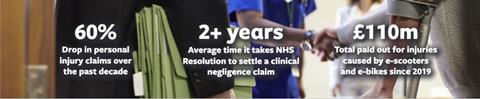
Over the past decade, personal injury claims have dropped by 60%, falling to a record low in 2025. APIL’s polling suggests that only one in five victims approached a personal injury lawyer and 44% of victims did not claim compensation.
Whiplash reforms introduced in 2021 overhauled how low-value road traffic accident personal injury claims are handled, bringing in a fixed compensation tariff and slashing the amount most victims received. The reforms also meant that victims could no longer recover legal costs from the wrongdoer. Since then, injured people have been far less likely to claim compensation.
APIL research shows that between 2020 – the year before the reforms were introduced – and 2025, road casualties increased by 11%, but motor injury claims fell by 43%, to another record low.
Stressful process
Meanwhile, those who continue to claim face increased barriers and a far more stressful process to access justice.
As part of the 2021 reforms, the Ministry of Justice introduced the Official Injury Claim (OIC) portal, a digital online system. The portal allows unrepresented claimants to process, manage and settle low-value claims (under £5,000) without initial legal representation.
Ministry figures show that over 1,380,000 claims have been made using the service since it was launched, including 145,000 made by unrepresented claimants.
APIL’s research suggests that many victims struggle to use it when they do not have help from a lawyer. Its analysis finds that for every 10 claims submitted by those without representation, more than six calls are made to the OIC’s support centre, suggesting it is not the easy-to-use portal promised.
The polling also reveals that 69% of adults in England and Wales were unaware of the OIC, while less than half of those with an injury affected by the ‘whiplash reforms’ were aware of the portal.
‘Change is inevitable,’ says Brett Dixon, vice president of the Law Society and a former APIL president, but he insists that it ‘should not come at the expense of access to justice’. Dixon agrees that the reforms have had a ‘detrimental’ impact and calls on ministers to improve the portal through search engine optimisation and better branding to make things easier for claimants.
The government is currently undertaking a post-implementation review of the reforms and will ‘shortly’ publish a report summarising the outcomes of the review and any next steps.
Accident report
Elsewhere, APIL’s report shows that while more people are suffering from work-related injuries or illnesses, the number claiming compensation has dropped by almost two-thirds.
In 2024/25, 854,000 workers suffered a work-related injury that led to more than seven days’ absence, or became ill because of their work – a 34% rise since 2018/19. Over the same period, there was a 51% drop in compensation claims. While these injuries and illnesses increased by 14% between 2023/24 and 2024/25, the number of claims fell by 1%.
APIL’s report notes that women are hardest hit by this justice gap. They are three times less likely than men to claim compensation for a work-related injury or illness. Since 2019/20, claims made by women have fallen by 13 percentage points more than men’s, despite women seeing a bigger increase in work-related injury and illness.
Victims of clinical negligence, meanwhile, are waiting a record-breaking length of time to receive justice, the report shows. On average, it currently takes NHS Resolution over two years to settle clinical negligence claims, an average of 10 months longer than in 2013/14. Victims with the most severe injuries face average waiting times of over eight years to settle their claim – almost two years longer than in 2013/14.
Criminal injuries compensation
The Criminal Injuries Compensation Authority (CICA) is an agency of the Ministry of Justice that pays compensation to victims of violent crime. Rates were set in April 1996 and the current maximum is £500,000. Campaigners argue this is too low, particularly given the impact of inflation.
Association of Personal Injury Lawyers (APIL) research finds that the ‘broken’ compensation system denies far too many the support they need. It shows that the maximum amount which can be awarded has fallen by more than half since 1996. In addition, most applicants do not have a lawyer and 86% receive less than half of the compensation achieved with the services of a lawyer.
Data obtained by APIL also shows a discrepancy between what is offered to victims of crime before and after an appeal. In cases that reached appeal in 2025/26, an average of £12,857 was initially offered, but the CICA’s offers increased to an average of £63,143 on appeal.
APIL’s most recent analysis found that only 3% of injured victims of crime go on to receive compensation, suggesting this is due to a lack of awareness of the scheme, a stressful claims process and restrictive eligibility rules.
MoJ figures reveal that demand for compensation has nevertheless increased significantly since 2020. In 2024/25, the CICA received nearly 43,000 new applications, finalised over 35,000 applications, and provided just over £164m in compensation under the taxpayer-funded scheme.
Ministry officials stress that victims of crime do not need legal representation to apply for compensation. They note that free, independent advice may be available from local support or other charitable organisations.
Applicants are entitled to request an internal review of a CICA decision, which they can then appeal to the First-tier Tribunal. In 2024/25, 12.9% of first decisions (4,874) went to internal review, while 2.7% (1,036) went on to appeal.
Of the appeals decided in 2024/25, CICA’s decision was upheld in 41.8% (474). Applicants received a higher award in 24.5% of appeals decided in 2024/25 (277).
Officials say that CICA is committed to improving the applicant experience through modernised communication, stakeholder collaboration and a trauma-informed approach.
Lifetime of risk
While most victims of NHS negligence receive compensation in the form of periodic payments, most other seriously injured people receive it in a lump sum, which APIL warns means they face a ‘lifetime of risk’.
If victims live longer than expected or inflation is higher than anticipated, they risk running out of the financial support they rely on. This means they can be forced to invest their lump sum in risky assets in the hope of receiving higher returns.
In contrast, periodic payment orders (PPO) provide compensation in instalments over a whole lifetime and are linked to inflation.
APIL’s report blames insurers’ resistance to periodic payments as the main barrier to victims receiving them. Its research shows that almost 90% of lawyers who sought a PPO for a client found it difficult to obtain from an insurer. The same percentage said that insurers always or very frequently sought to negotiate on a lump-sum-only basis while 82% said that insurers rarely or never proactively offer a PPO.
Claimant lawyers suggest that insurers make obtaining a PPO difficult by, for example, approaching clients post-settlement to see if they would swap a PPO for a lump sum, refusing to negotiate on PPO terms, and using the possibility of periodic payments as a reason to object to providing interim payments.
‘Insurers have never been enthusiastic about periodical payment orders. In many cases, seriously injured claimants still need to be prepared to take a case all the way to trial to secure one,’ says Ben Townsend, head of the personal injury practice at Stewarts in Leeds. ‘That can mean years of additional uncertainty, delay and expense before obtaining an outcome that provides the long-term financial security they need.’
Significant factors driving the justice gap, suggests APIL, include the move to fixed recoverable costs (FRC) (capping the amount of legal costs that victims can recover from the wrongdoer).
In cases affected by FRCs, the legal costs of pursuing a claim increasingly exceed what can be recovered. As a result, lawyers say they are unable to support an increasing number of victims who approach them for help because the amount that can be recouped is not enough to pursue the claim.
As legal costs rise and recoverable amounts stay frozen, fewer victims can obtain legal representation. This is leaving more injured people without access to justice.
Dixon says that the Law Society has ‘serious concerns that changes to the civil justice system – including the whiplash reforms and changes to fixed recoverable costs – have resulted in a negative impact on consumers of legal services’.
The extension of FRCs to most civil cases has not provided the promised costs certainty, says Dixon, calling for a review.
Fundamental dishonesty
Fixed costs, concurs Sophie Davies, head of personal injury at Osbornes Law, were ‘ungenerous from the outset’ and have not kept pace with inflation. As a consequence, she says: ‘Many firms have moved away from this work because it is impossible to offer a good service to the client at the level the fixed costs allow for.’ Other problems highlighted by claimant lawyers include more aggressive defendant behaviour and increased use of unmerited ‘fundamental dishonesty’ allegations.

The Criminal Justice and Courts Act 2015 gave courts the power to dismiss an injured person’s compensation claim entirely if, on the balance of probabilities, it is found that a claimant has been fundamentally dishonest.
‘Unsubstantiated allegations of fundamental dishonesty have become standard practice for some insurers,’ says Davies, which can deter claimants. Having to warn clients about this possibility, she adds, can create a ‘slightly sour tone’ as they think their solicitor is implying they might not be telling the truth.
As for defendants, there is very little to deter this bad practice, says Davies. Instances of a judge ruling unfavourably against a defendant for unsuccessfully pursuing unsubstantiated allegations are very rare.
'Many firms have moved away from this work because it is impossible to offer a good service to the client at the level the fixed costs allow for'
Sophie Davies, Osbornes Law
APIL president Guy Forster suggests that abuse of the fundamental dishonesty rules will likely only increase if it is unaddressed by regulators. He alleges that some defendants ‘cynically spray around fundamental dishonesty allegations in the hope that something will stick’. This is a bullying attempt to financially and psychologically exhaust claimants, claims Forster, likening it to SLAPPs (strategic litigation against public participation).
APIL warns that the growing justice gap harms not just victims of negligence but also has a significant financial impact on wider society – for example by increasing the amount the government spends on benefits for people unable to work.
Responding to the report from the defendant side, Bridget Tatham, president of the Forum of Insurance Lawyers, tells the Gazette: ‘Change has often been implemented by way of a carefully balanced package of reforms, seeking to preserve access to justice, update the process, reduce cost and discourage abuse. It is important that a modern process delivers access to justice to all parties, while also reflecting the need for fairness for taxpayers and those who pay insurance premiums facing rising living costs, who ultimately fund the provision of compensation.’
A government spokesperson says: ‘It’s vital that people who have suffered injury have access to swift justice.’ Acknowledging that ‘applying for compensation can be a difficult process’, the spokesperson adds that is ‘why we’re continually reviewing how to deliver more accessible, supportive, and efficient services’.

Most dangerous industries
Reviewing the changing types of claim that lawyers are seeing, Charlotte Dowson, a senior associate at Bolt Burdon Kemp, notes that many serious injuries arise from road traffic collisions, workplace accidents and incidents involving vulnerable road users. ‘Construction and agriculture remain among the most dangerous industries, and far too many of the cases I deal with involve injuries that were entirely preventable,’ she observes.
The BBC recently reported that the cost of damages paid out to people injured in the UK by e-scooters and e-bikes has topped £110m since the first claim was made in 2019. These claims are picked up by the Motor Insurers Bureau, contributing to the hike in insurance premiums for drivers.
E-scooters are classified as motor vehicles. Legislation introduced in 2020 enabled government-approved rental e-scooter trials, but privately owned e-scooters are illegal on roads, pavements and other public places, and therefore their use cannot be insured.
‘The law has not kept pace,’ says Dowson. ‘There is a strong case for reviewing the current framework, particularly around insurance and accountability, so that people injured in these collisions are not left without an effective route to compensation.’
The government has committed to pursuing legislative reform for ‘micromobility’ vehicles, including e-scooters, when parliamentary time allows. This will create safe, legal routes for people to use e-scooters, including for private use, and allow the focus to turn to enforcement with regard to anyone breaking those new laws. Next year, the government will also consult on longer-term e-scooter regulations, including registration and licensing.
Rise of AI
As with other areas of life and law, the use of artificial intelligence is affecting personal injury work. Davies has not been presented with any AI-generated claims material, but says clients are using it to inform themselves about the legal process and their possible entitlement. ‘In theory this is a good thing,’ she says, but notes that AI can often be wrong and lead to confusion and time spent disabusing the client.
Dixon says the Law Society is not aware of incidents that have been falsified through AI, though he reports signs that court documents and supporting materials have been created using AI tools. Some tribunals are seeing a rise in lengthy AI-generated submissions, which can increase judicial workload and lead to delays.
The challenge, says Dowson, will be ensuring that AI is not used to manipulate evidence or support fraudulent claims. She concludes: ‘As the technology develops, lawyers, insurers and the courts will all need to scrutinise digital evidence more carefully.’
Catherine Baksi is a freelance journalist








No comments yet