
























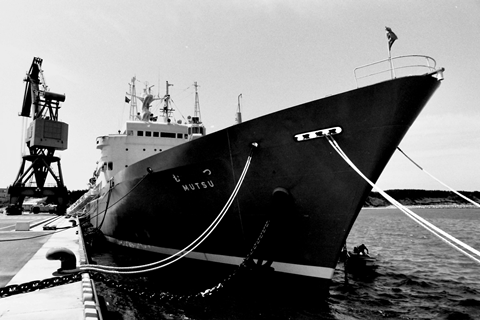
The saddest ship in which I ever set foot was also the most expensive. In summer 1990 I visited the Nuclear Ship Mutsu, an 8,000-tonne prototype cargo vessel as she prepared to leave her port of Sekinehama, northern Japan, for the first time under her own steam - 20 years after the first attempt.
Mutsu had a pathetic back story. She was launched in 1969, enabling Japan to join the Soviet Union, the United States and West Germany in the club of civil nuclear ship operators. But on her maiden voyage in 1974 she had to be towed secretly to sea to beat a blockade of protesting fishermen. At sea, as the crew started bringing the reactor up to heat, a leak was detected in the radiation shield. Mutsu drifted without power for 45 days while the crew fixed the leaking wax seal with a mixture of borates and rice prepared by the ship's cook - and the government hunted for a port to take her in.
The authorities eventually solved the harbour problem by building a new one for the purpose. Mutsu's reactor was painstakingly recommissioned. By the time of my visit, though, it was clear that civil nuclear shipping was going nowhere. The Japanese Science and Technology' Agency's determination to finish the Mutsu experiment seemed to me a case study in nintai - the spirit of indomitable persistence so admired in Japan.
So it was something of a surprise last month to encounter a claim that nuclear power shipping could be poised to enter a golden age. Powering the Future, the latest report by the busy - and famously opaquely-funded - free-market thinktank Policy Exchange, proposes that the UK establishes itself as the international rulemaker for maritime nuclear energy.
According to authors Edward Barlow and Daniel Skeffington, advances in compact reactor design, modular construction and marine engineering are making nuclear-powered merchant vessels and floating nuclear power plants commercially credible. 'The UK should therefore treat maritime nuclear technologies as a significant commercial, industrial and strategic opportunity with strategic consequences.'
Rather than becoming a nuclear shipbuilder, 'Britain’s opportunity lies in positioning itself as the rules, assurance and integration centre for Western civil nuclear maritime.'
It's an exciting prospect for a City which, after all, owes its origins to maritime finance and insurance. But I'm afraid that the idea that commercial shipping is about to switch to nuclear power is moonshine. As the report points out, there are systemic regulatory gaps, ranging from licensing to crewing, operational security and distress procedures to eventual decommissioning. 'A nuclear vessel that cannot reliably obtain cover, enter ports, satisfy cargo owners or demonstrate compliance across jurisdictions will remain a special project rather than a commercially viable ship.'
Would a new regulatory regime fill this gap? Today, nuclear energy is safer than any other concentrated source of energy because it is surrounded by - some would say suffocated by - a uniquely tough regulatory blanket. I detect no public appetite for its relaxation. Putting nuclear power to sea adds a whole new layer of risk, of a much higher order than a Mutsu-style containment leak. Sooner or later a world of commercial nuclear shipping would have to deal with crises ranging from collisions to hijackings to sabotage or overt attacks by hostile powers.
All this probably rules out nuclear power for today's shipping routes.
Intriguingly, though the Policy Exchange paper notes the opening of a new ocean: the high Arctic. According to the Financial Times, a Chinese container shipping company will this week launch the first regular container shipping service through the Arctic.
In this ocean, nuclear-powered shipping is already a reality - the only civil nuclear ships afloat today are Russian icebreakers. The Policy Exchange paper proposes 'deepening maritime and maritime nuclear cooperation with Arctic allies as this region becomes a site of geopolitical competition'. Hence the report's final proposal, the establishment of a 'bilateral regulatory sandbox' with the US. This would 'test licensing routes with selected developers, ports, insurers and operators'.
On the basis that a nuclear Arctic is inevitable, it makes sense for London to have a hand in the licensing regime.
Alas, the Mutsu won't be there. Her maiden voyage was delayed for another year after my visit. Eventually, between 1991 and 1992, she completed her design objective by steaming 50,000 miles in circles in the Pacific. She was then rebuilt as a diesel-electric powered oceanographic research vessel, studying, among other things, changes in the thermal cycle of the ocean, and finally retired last December. Perhaps she became a happy ship after all.
Michael Cross is the Gazette's news editor. He reported on nuclear energy developments in Asia, North America and Europe for several decades













No comments yet