


















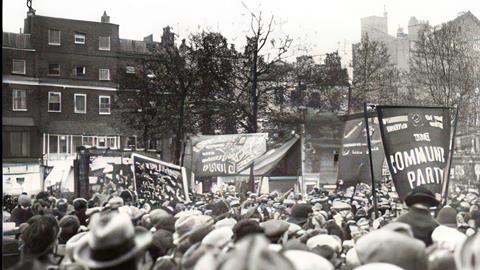

Some tried to conceal their truncheons; others emerged 'not minding the display' of their staves of office. So observed the Solicitors Journal and Weekly Reporter on the 'quite a number of young men' who appeared from the headquarters of the ‘Devil’s Own’ Territorial regiment in Lincoln’s Inn during the General Strike. The truncheon-wielders were members of the Special Constabulary, deployed under the Emergency Powers Act 1920 to prevent a breakdown in society during the nine-day protest which paralysed essential services a century ago next week.
A high proportion of those swearing a declaration of allegiance to ‘serve our Sovereign Lord the King in the office of Special Constable' would have been lawyers, reflecting the long-standing relationship between the Inns of Court Regiment and the profession. They would have enjoyed the widespread support of a conservative-leaning profession, many members of which did what they saw as their patriotic bit. At least one of the 10 civil commissioners appointed to run the country under emergency powers was a solicitor. Meanwhile, the attorney general’s son, Quintin Hogg (later Lord Hailsham), was ‘determined to be in the thick of it’ and helped run a fleet Renault lorries to collect refuse.
Certainly the legal press in spring 1926 contains little to show sympathy with the strikers, much less any report of lawyers downing pens in solidarity. The Law Society's Hall, for example, seems to have remained open throughout the nine days.
The national walkout, called by the General Council of the Trades Union Congress in support of coal miners striking over cuts in pay, began on 4 May. That week, the Solicitors Journal was more concerned with the Chancellor of the Exchequer's proposed tax on betting: 'Mr Churchill explained that the new tax was one on luxury or "option", as he himself preferred to call it.'
It was not until the following edition, on Saturday 15 May, that the strike made the legal news. The journal covered a parliamentary speech by barrister MP Sir John Simon (Spen Valley, Liberal) on the third day of the crisis, declaring the strike illegal. Any organiser, Simon thundered, would be 'liable in damages to the uttermost farthing of his personal possessions'. As David Torrance points out in his new history*, discussions of the strike's legality arose remarkably late considering the number of distinguished lawyers in parliament.
Simon was in the thick of several great events of the first half of the 20th century: he acted for the Board of Trade at the public inquiry into the sinking of the RMS Titanic; chaired the Simon Commission into the government of India and went on to become the first lord chancellor in Churchill's wartime government. The fact that he shared the national stage with such titans as Lloyd George, Attlee, Beveridge and Churchill may explain why he is largely forgotten today. That and his unsympathetic personal character.
In his speech Simon argued that the strike 'is not, properly understood, a trade dispute at all' and thus its perpetrators could enjoy no immunity under the Trade Disputes Act 1906. 'Once you proclaim a general strike, you are as a matter of fact, starting a movement of a perfectly different and a wholly unconstitutional and unlawful character,’ Simon said. Bowing to government pressure, the BBC later read out the speech on the airwaves (radio broadcasting of actual parliamentary proceedings would not begin for another 50 years).
Stanley Baldwin's Conservative government was initially lukewarm about Simon's intervention, worried that it might complicate its own plans for anti-strike legislation. But the following week the speech received judicial endorsement in the form of obiter comments by Mr Justice Astbury. Ruling on a ding-dong between the executive of the National Seamen’s and Firemen’s Union and militant officials, the judge said: ‘In his opinion, the so-called general strike was illegal and contrary to law, and those inciting persons to it were not protected by the Trade Disputes Act, 1906. There was no dispute whatever alleged to exist, except in the case of the mining industry.'
The Solicitors Journal declined to comment; the Law Society's Gazette, then a slim monthly volume devoted mainly to parochial matters, missed it entirely.
After nine days, the strike was called off - a decision which, along with the largely peaceful nature of the conflict, nurtured a comforting narrative that Britons were too level-headed a people for Bolshevism. The miners were starved back to work in the autumn. But some at the time - and socialist romantics thereafter - believed one more push might have led to revolution. One firebrand was Shapurji Dorabji Saklatvala, the Indian-born Communist MP for North Battersea, who was arrested ahead of the strike for incitement and breach of the peace. After refusing to be bound over, Saklatvala was remanded as prisoner 4472 to Wormwood Scrubs, where his daily Commons order papers were solemnly delivered.
Legal London played one more small part in the drama: just around the corner from the Law Society, W.H. Smith’s warehouse in Carey Street distributed copies of the British Gazette, the government's emergency daily newspaper edited by Churchill - allegedly given the job to distract him from more drastic action. Some copies were scattered by Vickers Virginia bombers of the Royal Air Force, despite one occasion in which they fluttered into the tail, jamming the control surfaces.
By the end of the strike, nearly 52,000 special constables had been recruited in London alone. Looking back on the strike on 12 June, the Solicitors Journal observed that the Special Constables Act of 1831 granted the specials full powers of arrest and the 'necessary weapons and equipment to carry out their duties'. Fortunately truncheons sufficed.
Meanwhile the 1920 Emergency Powers Act was last employed by the Heath government in the early 1970s, which declared five states of emergency in three years. Whether any future government will be tempted to open that page of the statute book remains to be seen.
*Further reading: The Edge of Revolution, David Torrance, Bloomsbury












2 Readers' comments