


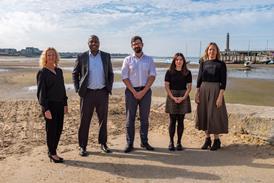




















Partner, IP and commercial, London
Esther Gunaratnam did not set out to become a lawyer – she wanted to be a scientist or engineer. She did a master’s degree in electrical and electronic engineering at Imperial College London. ‘I liked engineering because it’s applied science, not pure STEM.’

Esther says her English was not great when she came to England from Hong Kong at the age of 13. ‘Law seemed very daunting because it was English-language heavy. It never crossed my mind that I would become a lawyer.’
She enjoyed studying engineering at university, but the course was intensive. ‘I was doing mostly 9am-5pm every day except Wednesday when I had a half-day. My law degree friends would have 12 contact hours – the rest of the time was reading.’
One of her friends who also studied engineering did a law conversion course. ‘He said it was interesting. I thought, “Why not? Just have a go.” I filled in an application form and next thing I know I was accepted into the College of Law.’
'There is nothing you cannot learn. There’s a motto I find useful, "What you do not know, you can always learn". I’m still learning. Do not be afraid of the subject matter'
As part of the application process, she needed a reference. ‘I went back to my engineering supervisor. I wasn’t expecting a “no”, but he said “no”. I said, “You can’t refuse to be a referee”. He said to me, “Esther, there are not enough women engineers; you have got to stay in engineering.” The two struck a deal. Her supervisor agreed to be a referee provided Esther promised to become an IP lawyer. ‘I kept my promise.’ She secured a training contract at Bristows, one of the top IP firms.
What has her engineering background taught her? ‘I have learnt not to be afraid of the science.’ Esther says lawyers without a STEM background can find the science daunting. But, she explains, science is all about logic. ‘There is nothing you cannot learn. There’s a motto I find useful, “What you do not know, you can always learn”. I’m still learning. Do not be afraid of the subject matter.’
Every problem follows a similar formula. ‘First, you identify the issues. What are we trying to achieve? What do I need to achieve that? Analyse. Come up with some options for solutions. Do more analysis to arrive at whatever decision you make.’ During this journey, Esther adds, communication is key. Importantly, ‘you need to understand what the client’s objectives are’.
Her practice has broadened from IP law to IT, commercial matters and data protection. ‘I’m a non-contentious lawyer. I’m doing agreements, giving advice to clients about the law and thinking of solutions that would help my client to implement what they want to do in their business in a compliant way.’
For example, Esther says many clients will have AI tools they want to implement as part of their offering. In the health sector, various issues come into play. Is a data protection impact assessment needed? Does the privacy policy need to be updated for GDPR-compliance purposes? ‘There’s always a bigger picture,’ she says.
On that note, Esther tells me about a case in which her legal team defended a trade mark infringement. The team advised the client to settle, ‘but the client was adamant they did not want to be on the receiving end of a claim. We fought it and we won’. The trade mark was cancelled, which meant there was no infringement. However, the win had an unintended commercial consequence. There was no longer a monopoly on the trade mark, which in turn affected the price point. Her client would have to drop the price of their product to be competitive. ‘You might win on the technical side, but you might not win on the commercial side.’
Highlighting the breadth of her work, Esther recalls doing important biotech licensing and commercial agreements during the pandemic. One of her clients was developing ‘clever molecules’ as part of cancer research. ‘They realised they could tweak the molecule to make a Covid vaccine. It was an area of biotech licensing where I felt I helped in the pandemic in my own little way.’
She believes IP law has come a long way. ‘When I was doing law school, IP was two or three lessons as part of the commercial module. I learnt most of my IP practising. Now, there are specialist IP courses people go on at university. It’s become a cool legal area for good reason.’









No comments yet