






















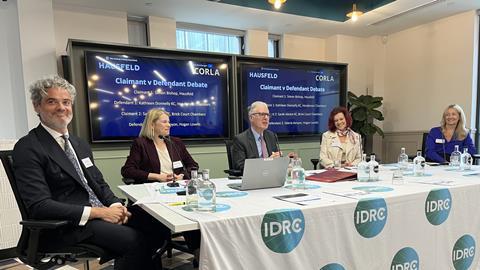
Quidditch, gin and tonic and yoga instructors all featured this week in a lively panel debate between claimant and defendant lawyers on whether the group actions framework is ‘fit for purpose’.

Much of the discussion, hosted by the Collective Redress Lawyers Association (CORLA), centred on whether opt-out class actions should be extended beyond competition law.
Arguing for an extension of the opt-out regime, Simon Bishop, partner at Hausfeld, highlighted the ineffectiveness of regulatory action: ‘Think about the FCA [Financial Conduct Authority] interventions into interest rate swaps mis-selling, which caused vast levels of under compensation; the current mess with Ofwat and water pollution; and car finance – where the FCA’s compensation scheme is already potentially subject to challenge. These interventions are fraught with difficulty.’
Bishop added that current collective redress mechanisms cannot fill the gap. He said: ‘What exists is unsuited to the breadth and types of harm that demand a remedy. The wrongs that consumers and small businesses suffer most extensively: financial mis-selling, unlawful data use, environmental harms, product defects, unfair contractual terms and broader consumer protection violations do not fit into the only functioning opt-out mechanism, in the CAT [Competition Appeal Tribunal]. They are also often unsuited to fit into opt-in [mechanisms] such as GLOs [group litigation orders], including because they cannot be funded, or representative actions under CPR 19.8, the scope of which has been interpreted narrowly by the courts.’
The solution therefore lies in a broader opt-out mechanism not limited to competition law, which must include provisions for robust certification, summary assessment and potential dismissal, to avoid spurious claims and ensure defendants are not at a procedural disadvantage, he argued.
Brick Court’s Sarah Abram KC added that the lack of an opt-out regime outside competition law means ‘if you happen to be harmed by a product defect or breach of environmental law, the barriers to redress are much higher than if you had to pay too much for your Waitrose smoked salmon because of an [alleged] cartel between salmon producers’.
Abram observed that obtaining certification in collective actions ‘feels like a game of Quidditch, where you’ve got to catch the elusive Golden Snitch’. Citing examples from the Supreme Court, she said the 2020 Merricks v Mastercard ruling had apparently ushered in an era of permissiveness for competition claims, only to be followed by Lloyd v Google just a year later – in which the same court strongly discouraged representative actions for data breaches. ‘The uncertainty about the threshold these claims must meet in order to be brought is a real-world impediment to obtaining redress,’ she warned.
Henderson Chambers’ Kathleen Donnelly KC argued in support of the existing GLO structure, which she said is ‘fighting fit’ at 26 years old. ‘Like a hot yoga instructor, flexibility is one of its key assets,’ she quipped, pointing to its successful use in resolving civil claims for 555 sub-postmasters with different contracts and causes of action.
She added: ‘What about opt-out actions? We’ve seen increasingly creative efforts to dress claims up in competition clothing to get through the door of the CAT, and now we have a chorus from the claimant lawyers – from claimant lawyers, not from claimants – calling for opt-outs for consumer litigation… How onerous is it really for an individual who wants to bring a claim, to be expected to actually sign up to it? Isn’t that the absolute minimum that we can expect?’
Donnelly said she had recently heard it suggested that consumer opt-out actions were needed to address a ‘structural shift in the nature of harm, to low-level, intangible harm’. She questioned whether such low-level harm necessarily required ‘the valuable time of our courts and judiciary to deal with’.
However, Abram noted that even where a class action may only be worth, for example, £10 per individual, this could be worthwhile for those struggling to make ends meet, and represents an hour’s work at the minimum wage. ‘It [wouldn’t be] attractive for “fat cat” London lawyers like me to be saying that a tenner per claim is not worth the candle,’ she suggested.
Valerie Kenyon, partner at Hogan Lovells, added: ‘What’s uncomfortable to me is that that small amount of money, be it £10 or £100, becomes infinitely smaller by the time all of us in this room, and our colleagues, experts and so forth, have been paid; and it takes so long to get it into the pockets of the claimant who deserves it.’
Kenyon cautioned against expanding the opt-out regime, warning: ‘The real risk here is that in trying to fix what isn’t broken, we hand over the keys – the claimants’ damages – to litigation funders’.
Arguing in support of the existing GLO mechanism, she said: ‘The GLO is deceptively simple. It’s like that slightly kitsch gin and tonic surrounded by its flashier contemporaries when you go to the bar on a Friday night. But it still packs a punch.’





No comments yet