























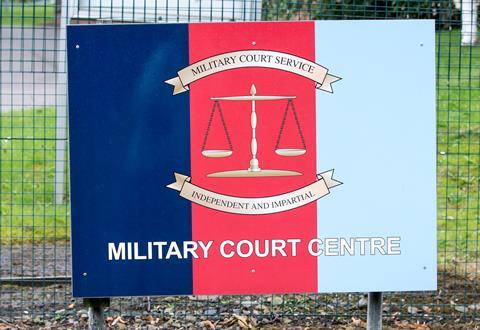
First hearings listed within 42 days, legal aid and representation checks conducted in advance, ‘exemplar’ portable court arrangements, and effective communication with lawyers, probation and judges. These are some of the features of the largely invisible Military Court Service revealed in an inspection report today.
Anthony Rogers, chief inspector for the Crown Prosecution Service, said the Military Court Service’s work often goes unseen but ‘is fundamental to deliver fair and effective justice for those who serve’.
The CPS inspectorate was invited to inspect the service, which provides a criminal court for the Royal Navy, Army and Royal Air Force in the Court Martial, Summary Appeal and Service Civilian Court.
Today’s report reveals that in 2025-26, 96% of plea and trial preparation hearings were listed within 42 days of receipt and 95% of those hearings were effective. The inspection found that routine legal aid and representation checks are conducted 21 days before the hearing to identify any issues that might affect the case’s progress. Court staff monitor compliance with directions, send reminders, chase outstanding actions and refer matters back to the judge for further case management if necessary. Only one trial is listed at a time.
Inspectors hailed the service’s courtroom and portable court technology as ‘an exemplar that the civilian justice system should aspire to’.
Read more
They observed staff establish a portable court in a disused military facility in Belfast ahead of a week-long trial: ‘Our observations provided direct evidence that the MCS could transport equipment securely, deploy laptops for participants, establish audiovisual and recording arrangements, and put in place the connectivity needed for the court to operate. Staff did checks before the trial began, and the process was organised, practical and well understood.'
The inspection also found effective communication between the service and defence lawyers, probation and judges. ‘One defence practitioner contrasted the culture within the MCS favourably with their experience in the civilian criminal courts, describing an environment in which defence representatives are treated with dignity and respect,’ the report says.
Findings on the service’s administrative systems were less glowing. Listing, case progression and related court administration 'remain dependent on fragmented systems, spreadsheets and manual workarounds'. The service was ‘dependent on experienced individuals, informal knowledge and manual systems that could become vulnerable if key staff leave, demand increases or workload shifts’.
Rogers said recommendations in the report were 'not about fixing failure' but about 'helping the service protect and build on what is already working well, so that this standard of justice is enhanced in the long term'.
This article is now closed for comment.





3 Readers' comments