























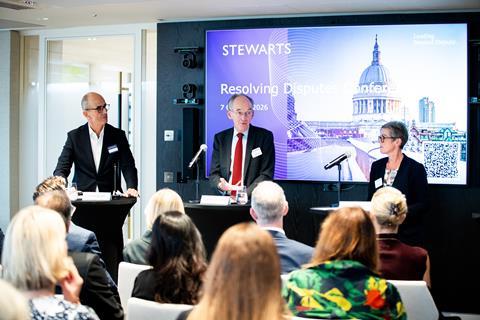
Solicitors and lawyers must do more to help raise awareness of out-of-court dispute resolution while the judicial college must improve on how it teaches judges about the alternatives to court, judges have said.
Speaking at a conference organised by litigation firm Stewarts, the former president of the family division, Sir Andrew McFarlane, acknowledged that judges are not taught in judicial college enough about out-of-court resolution relating to the family and children cases. He said: ‘I think it will be rare for a judge, on their own bat, to suggest early neutral evaluation or a private DRA or arbitration in a children case.
‘Why is that so? I think, wrongly, but I think some people have a feel that arbitration sounds like a commercial process…there is a feeling it might not be appropriate for children to be the subject of arbitration. I think that is a feeling some judges have, some practitioners. But the more you think about it, it is wrong.
Referring to education, McFarlane said: ‘I think it is not something taught on the judicial college courses for judges in the same way it is kind of the DNA of a judge doing a financial case.'
Read more
He told the audience it was ‘incumbent on all the judges to wise up about this for children’ and ‘for all of you to be positively raising it as a number one topic’ in a case where dispute resolutions could work.
Asked how family courts are dealing with non-court dispute resolution, Her Honour Judge Michelle Corbett, who retired last year, said had she been asked then her answer would have been different. Now, she said: ‘I do not think we as judges are, were, sufficiently aware of the options that there are. I think this is two educational processes. Trying to get the judicial college and/or the magistrates association to understand more about what is available and what is meant by NCDR [non-court dispute resolution].
‘But also, from the solicitors and counsel appearing in front of the judges to tell the judge or remind the judge about their duty to consider NCDR at every hearing. It is their duty. No judge does not want to fulfil their duty in court.’
She suggested that solicitors and their counsel ‘that in your position statements you even highlight it at an early stage. What is available out there that is an alternative and an addition to what is happening in court. How quickly can you get an arbitrator of your choice to deal with these issues’.





No comments yet