



















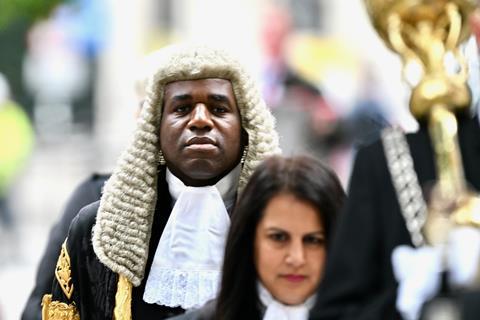
Lord chancellor and justice secretary David Lammy will today confirm if he intends to scrap jury trials for all but the most serious cases as part of wider efforts to tackle what he has declared a ‘courts emergency’. Lammy will confirm his plans in a statement to the House of Commons this afternoon but an interview with BBC News this morning suggests the right to a jury trial will be curbed.
The Ministry of Justice announced that Lammy, who is also deputy prime minister, will set out ‘the most sweeping modernisation of the criminal courts in a generation’ today. Lammy said he was ‘calling time on the courts emergency that has left victims of the most serious crimes waiting years for justice and pushed the justice system to the brink of collapse’.
With the record Crown court backlog predicted to hit 100,000 outstanding cases by 2028, Lammy said the government ‘must be bold’ and he will ‘set out a fast and fair justice plan that gives victims and survivors the swift justice they deserve.’
A leaked briefing from Lammy to ministers and civil servants last week revealed that only rape, murder, manslaughter and ‘public interest’ cases would be heard by a jury. Defendants charged with offences carrying a sentence of up to five years would be tried by a judge alone, which goes beyond the three years recommended by the Leveson review of criminal court delays.
Speaking to BBC News this morning, Lammy said 90% of work in the courts are done by magistrates, who can impose sentences of up to one year. 'If you steal an iPhone this afternoon in Currys, should you be able to opt to have a jury? The trial takes two days. Inevitably that will cause further delays for more serious and egregious comes like rape and murder. That's the question I have been looking at and will be announcing later on today.'
BBC News presenter Jon Kay highlighted tweets posted by Lammy when Labour were in opposition, in which Lammy said criminal trials without juries were a 'bad idea', and replacing juries with a judge and two magistrates would reduce diversity of those making life-changing decisions about guilt.
Read more:
Lammy said the backlog was 42,000 cases at the time of his posts. 'The facts have changed. Because of that, it's important to reflect on reforms that Sir Brian Leveson has suggested to the government.'
Lammy added that in his landmark review on the treatment of black, Asian and minority ethnic people in the criminal justice system, he made recommendations about judicial training and diversity. 'All of that has improved since I did the Lammy Review. The real issue I was concerned about was scrutiny and accountability and transparency of decisions made by our judges. AI technology means decisions can be read and understood, and can be transcribed. I will be announcing plans on what more we can do in relation to our magistrates in that area.'
Last week's leaked memo sparked an immediate backlash from solicitors and barristers, and an urgent question in the Commons chamber. Critics will have to wait for Lammy's statement in parliament this afternoon for the full details - today's press release merely states that he will set out how the government will ‘free up Crown court time so the most serious crimes are heard swiftly and fairly’ and ‘create faster routes for lower-level cases, as in Canada’.
In part one of his criminal courts review, former Queen’s Bench Division president Sir Brian Leveson ‘concluded that there are certain circumstances where a trial by judge alone is appropriate, which is the case in common law countries such as Australia, Canada and New Zealand. This is based on the need for cases to be resolved in a more timely manner, in a forum most proportionate and suitable to the alleged offence or offences’.
Also in today's announcement: up to an extra £34m a year in criminal legal aid fees for advocates and match-funding an unspecified number of pupillages.
This article is now closed for comment.








9 Readers' comments