
























Women go into – and then leave – practice in greater numbers than men. Why? And what can be done to stem this loss of talent? Maria Shahid reports
The low down
Women now vastly outnumber men at the point of entry into the profession. Almost two-thirds of solicitors admitted to the roll are women. But women are much less likely than men to stay. Under the age of 55, they leave at twice the rate of their male peers. That is a significant loss of talent, knowledge and experience. The exodus is most marked in private practice. Perhaps too many law firms are still designed to favour people, disproportionately men, who fulfil fewer caring responsibilities. Greater flexibility would help, but sexism and sexual harassment linger in many workplaces.
Every year, some of the brightest women embark on a job in the law, full of drive and ambition, hopeful that a long and fruitful career awaits in their chosen profession.
According to recent Law Society data, 53% of practising certificate holders are women. However, that headline figure masks the fact that the profession is demonstrably bad at retaining its women solicitors, who make up almost two-thirds of newly qualified entrants.
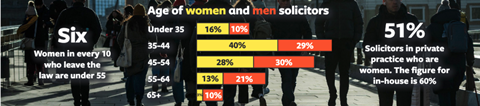
In practice, somewhere between qualification and, in law firms, partnership, aspirations fade and many women decide the law is not for them. Six in 10 female solicitors who leave the roll are under 55, compared with just three in 10 male solicitors of the same age. For those who stay in the profession, there is a notable flight to in-house positions, in particular the public sector.
‘The profession does not have a problem attracting talented women into law,’ explains Amandeep Khasriya, chair of the Law Society’s Women Solicitors Network and a consultant at Moore Barlow. ‘The opportunity lies in retention, in redesigning career pathways so that more women stay, progress and fully enjoy the rewards, recognition and influence that leadership roles should bring.’

Women’s reasons for leaving their legal careers vary. Structural inflexibility, particularly around caring responsibilities, and a roll-back on flexible working policies are just some of the factors at play.
A study by the University of Birmingham Law School found that reasons for leaving ranged from supporting a partner or spouse’s career, to concerns about the hierarchy of law firms and worries about caring for children while fee-earning.
Victoria Moffatt, a non-practising solicitor and founder of legal PR and marketing consultancy LexRex Communications, stepped away from her last fee-earning role in a high street practice 15 years ago: ‘I left when I started thinking about having kids. Being there for your clients is so all-encompassing that I just couldn’t see how I could parent in the way I wanted to while being a practising lawyer. I just didn’t feel the job was going to give me the leeway to do that, and I couldn’t see anyone else doing it.’
Former solicitor Annmarie Carvalho is founder of the Carvalho Consultancy, which focuses on therapy, coaching and training for the legal sector. She left the profession following several personal challenges, illnesses and bereavement, all while working towards partnership. Carvalho, whose husband was on the same career path, decided to leave practice after finding out she was having IVF twins: ‘It became glaringly obvious that something had to give. We could not both continue careers in law in the traditional sense and raise our kids the way we wanted to.’
Taking the pledge
'Women do not need more advice on confidence or resilience. They need workplaces that genuinely work'
Amandeep Khasriya, Law Society Women Solicitors Network
The Women in Law Pledge was created by the Law Society (in partnership with the Bar Council and the Chartered Institute of Legal Executives) in 2019 to promote gender equality in the legal profession. Its object is to commit organisations to supporting the progression of women into senior roles, focusing on retention and promotion opportunities, and setting clear targets on gender equality and diversity.
The pledge has now been signed by over 200 law firms and organisations. However, at this distance from its launch, Khasriya believes that ‘the focus now must shift to ensuring those commitments translate into practical, non-performative change’.
She voices a growing frustration with firm-led initiatives that feel ‘vapid and trite’. Too often, such initiatives place the onus back on women. ‘Women do not need more advice on confidence or resilience. They need workplaces that genuinely work,’ she says.
The biggest challenges are often in the over-45 age group, notes Khasriya. ‘I call it the perfect storm for women,’ she explains, ‘as it’s often the age when women are supporting their children at school, as well as managing ageing parents, all the while carrying out some of the most senior and demanding responsibilities of their career – leading a team, supervising junior lawyers as well as reporting upwards.’
For most women, this is also the age when health challenges can begin to emerge related to perimenopause and menopause, she adds. After the age of 55, there is another notable drop in the number of female practising solicitors. This cohort comprises 13% of women in practice compared with a figure of 21% for men (see bar chart, p17).
Dana Denis-Smith is CEO of Obelisk Support, which provides legal support to in-house legal teams and law firms, and the current deputy vice president of the Law Society. She is an advocate for keeping women in their 50s and 60s in the workforce. Obelisk has been running a returner programme for 14 years.
‘From my perspective,’ she says, ‘the real “hidden workforce” is made up of mid-career and senior women, whose careers have been interrupted by caring, health or other life events, and who are too often treated as if they have stepped away from the profession for good.
‘Many of these lawyers do not want to retire early; they want to work differently on terms that are sustainable and respect their wider responsibilities. When returning women lawyers are given the right structure, they quickly become some of the most productive and committed contributors to a team.’
Out of practice
Data from 2019 to 2024, compiled by recruiter Edwards Gibson, found that the recruitment of senior women varies according to practice area. Higher-margin transactional areas, such as corporate and capital markets, tend to have a much smaller proportion of female hires – between 15% and 20%. By comparison, areas such as litigation and real estate are generally far more representative of the market, with around 30% of hires. Employment, environment and pensions have close to a 50/50 split.
Company director Scott Gibson suggests this may be due to the better work/life balance in these practice areas.
The same data revealed that while the number of female hires at senior level stands at around 30%, the number of vertical hires, meaning hires from non-partnership to partnership positions, is higher, standing at 40%. Gibson says: ‘We would speculatively suggest that this may be caused by firms that are trying to address the gender gap.’
Motherland
The challenges for women lawyers start long before midlife. Returning to private practice after maternity leave, many female lawyers face the dual challenge of bridging the gap in their post-qualification experience (PQE) while they were on leave, while still meeting relentless billable hours targets that are too often set by bosses with little understanding of their situation.
Research conducted by BlueSky, which provides group workshops and coaching for women in law during motherhood, found several structural and cultural pressures standing in the way of those returning after maternity leave. Only 38% of returners felt positive about their career at the three-month mark.
Coaching consultancy BlueSky’s co-founder Hannah Bradshaw is a former employment lawyer. She explains that women returning to the law after maternity leave face several obstacles, the biggest of which is how firms gauge the seniority of a solicitor. ‘The PQE system is unique to the law and keeps running when women are on maternity leave,’ she explains. ‘You can have a situation where a woman is being judged at a higher level than they are able to perform at, without any understanding or support of any kind to get them back to where they should be.’
However, Khasriya warns that ‘acts of kindness’ by managers can, in fact, hold back women’s careers. ‘There can be an assumption that you don’t want the meaty work, because you don’t want to work the hours. That’s all well and good, but it can also hinder promotion,’ she says. ‘The work you are allocated can really make or break the next steps in your career.’
The impact of structural inflexibility on caring responsibilities is another big reason why women are leaving the law, adds Khasriya. ‘One focus area going into 2026 for the Law Society’s [Women Solicitors Network] committee is flexibility in law and making sure that firms don’t row back on the hybrid working model that has become established since the pandemic, which has benefited women enormously.’
Law firms can be slow to offer the type of flexibility that is both ‘necessary and attractive to retain key female talent, particularly at the critical senior associate level’, says David Evans, founder of employment law firm EPR Law.
Nikki Alderson, a former barrister and specialist coach, notes that the return-to-office mandate is putting off women. ‘Trust in your workforce, flexibility and building that into the system is what has seen women thrive,’ she urges. ‘The pandemic demonstrated how firms could still operate successfully while offering remote or flexible working.’
When it comes to billing targets, the overarching view is that these do not work in favour of mothers. Khasriya adds: ‘The burden on women in private practice, the inflexibility with chargeable time, is [heavy]. I am not sure what the answer is to that, but I do know that recording every six minutes of your time as a private practice solicitor and as a woman with other demands on your time is incredibly challenging.’
‘Billable hours mean that the law is a uniquely hard profession to work in as a mum,’ says Bradshaw. ‘You may have limitations on time, which probably also means you work more efficiently. In practice, though, you are not being rewarded for that because if you are 20% more efficient, you are actually performing 20% less.’
Road to partnership
'The reality is that change isn’t going to be effected without commitment from the most senior leaders'
Alison Eddy, Irwin Mitchell
Female solicitors in private practice have a 13% chance of reaching partner-equivalent levels, Law Society figures from 2023 revealed. Meanwhile male solicitors in private practice have more than double the opportunity with a 28% chance.
In 2024, the percentage of female partners in law firms stood at 35%. While this was a slight increase on the preceding year, progress has been slow.
Alderson believes that opacity regarding the path to partnership is partly to blame for the continuing gender imbalance: ‘There’s a lack of transparency about what you actually have to do to get to partnership, and that can act as a disincentive for women, who may decide to leave instead.’
Alison Eddy, partner ambassador for inclusion at Irwin Mitchell, and former managing partner of the London office, explains how the firm achieved its ratio of 50% female partners. ‘The reality is that change isn’t going to be effected without commitment from the most senior leaders,’ she says.
Inspired by former Law Society president Christina Blacklaws, the firm set up a series of roundtables to explore what women saw as barriers to career progression. ‘There were no surprises,’ Eddy says. ‘Unconscious bias – for example women returning from maternity leave, for often benign reasons, were not given tasks that might have meant long hours but would set them up for promotion. Also, the ability to work flexibly was seen as key to women advancing their careers, as was a need for mentoring and relatable senior female role models.’
Khasriya, a former partner at Moore Barlow before becoming a consultant, explains how her firm achieved 55% female representation at partnership level. ‘There has been a lot of investment and we are listening to people,’ she says. ‘We also have a really interesting way of rewarding our partners. One of our key metrics is their contribution to diversity and inclusion, and to our culture.’
Of course, partnership is not the goal for all women. Carvalho explains: ‘Over the past eight years, since I left law and began to practise as a therapist, more women and men have reported that they are not interested in partnership. They are not interested in climbing the ladder in the traditional sense. They want to lead a more holistic, rounded life. Often, they come to this decision after experiencing the difficulties of life and work.’
Dissatisfaction and discrimination
There are other barriers to progress beyond those, such as motherhood, which are most commonly cited. According to the Law Society’s Practising Certificate Survey 2023, women are less likely (70%) than men (80%) to consider their organisation a fair and equal employer.
‘Women leave the law for a multitude of reasons,’ says Karen Jackson, founder and chief executive of niche employment firm didlaw. ‘There is simply very little consideration of the impact work has on wider life. Women are not prepared to tolerate this sacrifice in the way that men are. You can be really good at a job but still want to confine your hours to a moderate amount. It doesn’t mean you’re not doing a good job, but that is not the view in many firms.’
Jackson, whose firm acts on discrimination claims, adds that casual sexism and sexual harassment also play a role, as does dissatisfaction with the perceived status quo. ‘Women get fed up with being objectified,’ she says.
Florence Brocklesby, founder of Bellevue Law, regularly advises lawyers and law firms on potential discrimination issues. She notes that these often arise when women return from maternity leave, and relate to working hours and chargeable-hour targets, as well as client and work allocation.
‘For older people, often older women, there are caring responsibilities relating to ageing relatives that can throw up similar issues,’ she says.
More than window dressing
The gender balance at senior levels is unlikely to change dramatically unless a cultural shift takes place. Carvalho predicts: ‘Until we can create a profession where the demands of the clients and the work somehow fit with those of family and extended family life, and which is more psychologically safe, we will continue to see women, and some men, leave the profession in droves.’
She advocates for a more holistic approach to rewards, appraisals and benefits, by moving away from a figures- and targets-based approach for individual lawyers.
On a firm-wide level, however, data could be key to retaining women in the profession, says Alderson. Gauging how firms are actually performing is vital to bring about that cultural change, and to see whether measures that are brought forward are actually working, ‘as opposed to just being window dressing’.
Maria Shahid is a freelance journali








2 Readers' comments