





















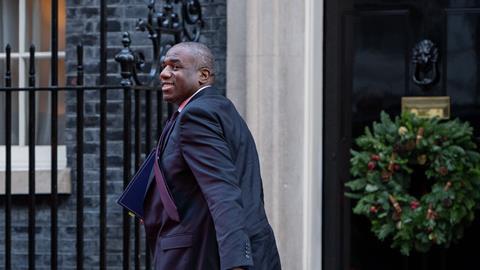
Lord chancellor David Lammy has scaled back on axing jury trials for all but the most serious cases – but his plan to cut the Crown court backlog has failed to appease critics.
To tackle what he declared a ‘courts emergency’, Lammy announced a ‘bold blueprint’ to turn the tide on the rising backlog as recommended by Sir Brian Leveson's independent review. However, while Leveson recommended a new tier of court in which certain cases would be heard by a judge flanked by two magistrates, Lammy’s ‘swift courts’ will have judges sitting alone.
Law Society vice president Brett Dixon said Leveson’s recommendation at least retained an element of lay participation. ‘Allowing a single judge, operating in an under resourced system, to decide guilt in a serious and potentially life changing case is a dramatic departure from our shared values,' he said. 'The government cannot justify stripping away this fundamental right without publishing clear evidence that putting more cases in the hands of a single judge will tackle the horrendous backlogs in our courts.’
Of particular concern within the City is the ending of jury trials for complex fraud cases, as recommended by Leveson. The Ministry of Justice said this would free up jurors ‘who have to give up months of their lives to hear particularly burdensome cases’.
Neil Blundell, vice-chair of the City of London Law Society’s committee on corporate crime and corruption, said serious and complex fraud cases account for only a very small proportion of Crown court work and when properly managed, can be easily catered for in the jury system.
‘Removing juries in such cases would not resolve systemic pressures and would instead create new burdens for courts and judges including the need for detailed reasoning on verdicts which will add to the administrative burden for judges,’ Blundell said.
Sam Tate, global head of regulatory and investigations at Clyde & Co, said: ‘Looking across to our judge-determined commercial courts that hear civil cases with similar fact patterns to financial crime prosecutions, their complex cases last year had significant time spent on legal argument, pre-reading, preparation and judgement. It therefore does not appear to be obvious that there will be time saved by moving from jury trials to judge trials. Whereas there would be an obvious time saving by simply allowing more sitting days for criminal judges.
‘Imagine a world where to save administrative costs we simply materially reduced professional standards that had been established for hundreds of years. Too many patients? Remove the Hippocratic oath or apply it only to the most serious injuries. It could be a very slippery slope.’
Neil Swift, a partner at Peters & Peters, warned that Lammy’s plan could create a ‘perverse incentive’ to get cases heard before a jury. Swift said: ‘Many offences have a maximum sentence of imprisonment of five, seven, 10 or 14 years. It is not clear what mechanism will be used to decide whether an accused charged with such an offence is likely to receive a sentence of up to three years, but assuming the defence has a say, this creates a perverse incentive for the defence to characterise alleged offences as more serious to get the case before a jury.’
David Corker, a consultant at Corker Binning, said the government should have adopted a model working successfully in Canada and most of Australia, where defendants in serious fraud cases have the right to choose to be tried by a judge or jury. Corker said defendants in complex cases predominantly to be tried by a judge, 'so the outcomes attract their and the public’s confidence'.
This article is now closed for comment.







32 Readers' comments