








The incoming chair of the Legal Services Board has signalled that frontline regulators will face a new type of scrutiny in the wake of high-profile failures.
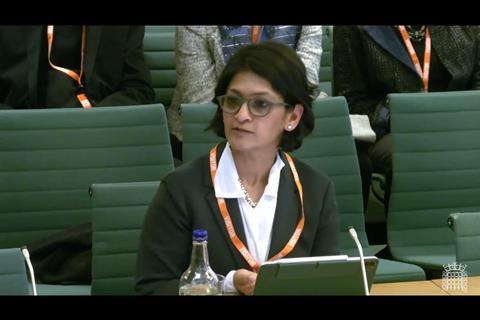
Monisha Shah, the government’s preferred candidate for the post, faced questioning ahead of her appointment from the House of Commons justice committee yesterday.
MPs probed her on her experience and knowledge of the legal sector, how she would fit in the job around her six other roles, and how she saw the oversight regulator changing in response to events of the past two years.
This is a critical time for the LSB: it has criticised regulators such as the Solicitors Regulation Authority and BSB for their failings and is also subject to an ongoing review by the Ministry of Justice about its own effectiveness.
Asked specifically about enforcement action against the SRA following the collapses of law firms Axiom Ince and SSB Law, Shah said she was aware of the accusation that the LSB oversight of regulators was ‘light touch’, and stressed the need for the organisation to be more pro-active.
‘When enforcement action is necessary the harm has already occurred,’ she said. ‘To me that demonstrates a need for greater market surveillance both from the frontline regulators but also from the LSB. There are some very clear lessons to be learnt from that experience and event. Consumer detriment is incredibly significant when large law firms fail and that should never be under-estimated.
‘In the current climate I think that the authorisation processes need to be more risk-sensitive especially for growing firms with complex ownership and funding structures.’
Read more
The LSB holds regulators to account through a performance assessment framework which assesses how these organisations meet certain criteria and reports once a year. Infamously, the SRA received top ratings in the LSB’s assessment published in February 2024 – just months after making multiple errors in the handling of the Axiom Ince affair. This assessment led the LSB to conclude that the SRA’s performance ‘raises no concerns’.
Shah said there is now a need for a ‘different kind of supervision that has to be ongoing and intelligence-led rather than simply periodic and reactive’.
Shah insisted she would be able to fit her LSB role – for which she will work 70 days a year for a £63,000 salary – alongside her six other non-executive positions. She said her existing commitments take up between two and a half and three days a week, leaving enough time to devote to her legal role.
She will step down as a trustee of one charity in June and will leave her position as chair of the panel that recommends lawyers for appointment as King’s Counsel at the end of next year. Shah stressed there was no conflict in the meantime between the KC position and being chair of the LSB.
With a background largely in the media – she was a BBC executive for more than a decade – Shah admitted she had little experience of managing an organisation subject to public scrutiny or a public bodies review. But she added she was confident she would be able to ‘add value’ to the work of the LSB.





No comments yet