
























The government’s plans for an Interest on Lawyers’ Client Account scheme are flawed – that was the consensus at a recent conference exploring how existing ILCAs operate internationally
The Ministry of Justice is sifting through responses to its consultation on seizing law firms’ client account interest to fund a ‘sustainable justice system’. The Solicitors Regulation Authority’s response is the latest submission to emerge, with the regulator warning that the MoJ’s proposed arrangements could impose new costs on the profession. The Law Society and UK Finance have also raised concerns.
But the ministry is not necessarily breaking new ground with an Interest on Lawyers’ Client Account (ILCA) scheme. Dozens are already in operation across the world and have been explored in a two-year Nuffield Foundation-funded research project led by Linda Mulcahy, a professor at the University of Oxford’s Centre for Socio-Legal Studies. The research team includes the Access to Justice Foundation and the University of Surrey.
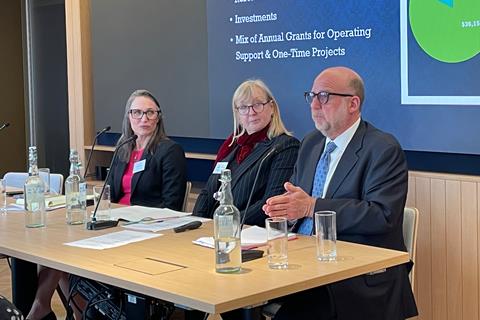
Last week, the Centre for Socio-Legal Studies and Access to Justice Foundation hosted a conference at international firm Dechert’s London office that discussed how much money the MoJ might have to play with, what currently happens to client account interest, law firm obligations, how international schemes operate, and the opportunities that the right scheme for England and Wales could bring.
How much interest do client accounts generate? Mulcahy pointed towards the Law Society’s 2024 financial benchmarking survey of 147 solicitor firms with a combined income of over £1.5bn. Total net interest income jumped from £2.6m in 2022 to £27.5m in 2024.
The MoJ wants to take 50% of the interest generated on individual client accounts and 75% on pooled accounts. However, unlike many schemes overseas, the cash would be remitted into an MoJ-administered central fund. This is a source of unease, with not-for-profits fearful that cash earmarked for civil legal support services will cross-subsidise prisons and the wider criminal justice system.
'We have a real benefit of coming to this 60 years after everyone else. We can just pull out everyone else’s lessons and get it together'
Julie Bishop, Law Centres Network
The MoJ should pay heed to what other ILCA schemes are doing. The conference heard that in the US state of Illinois, the interest goes to The Lawyers Trust Fund of Illinois (LTF), a non-profit foundation. LTF makes grants to organisations that provide a legal safety net for low-income people with urgent needs.
LFT executive director Mark Marquardt finds the idea of the MoJ administering the scheme problematic. He told the conference that foundations are like venture capital funders and are able to take risks. They have more room to manoeuvre and can be diverse in supporting the transformation that the justice system needs. ‘The government has an important role to play to come behind that and lift some of these things up to scale,’ Marquardt said.
Mulcahy said the research backs having an independent not-for-profit foundation administer the scheme. The operators of some schemes ‘do not think it’s dignified for the state to be getting down to the nitty-gritty of what interest rate Barclays Bank is going to give us,’ she said.
The conference was reminded of the crisis of unmet legal need. With asylum legal aid provision, for instance, barrister Dr Jo Wilding said the overall minimum ‘deficit’ – people claiming asylum unable to access a legal aid lawyer – reached 57% in 2023/24. A council started sorting out serious disrepair and mould in a tenant’s flat only when a solicitor became involved. A report published by thinktank Justice, the University of Sussex and Dechert highlighted the difference that legal representation made to survivors of the Windrush scandal seeking compensation from the Home Office.
Judge Amy Dunn Moore, chair of the American Bar Association commission on interest on lawyers’ trust accounts, told the conference that the provision of legal aid ‘is one of the most important hedges against abuses of government and one of the most important ways we can make sure systems that oppress people and keep them in poverty are challenged’. She took an oath when she was sworn in as an attorney. ‘It’s our professional responsibility to put our money where our mouth is.’
Julie Bishop, director of the Law Centres Network, said law centres receive 80% of their funding from philanthropic organisations – for three years if they are lucky. They are currently ‘standing on a burning platform’. With an ILCA scheme, ‘we have a real benefit of coming to this 60 years after everyone else. We can just pull out everyone else’s lessons and get it together’.
While views on an ILCA scheme differ, the general consensus is that the MoJ’s design is flawed. The ministry may want to postpone its response until Mulcahy’s research, which is exploring other funding models – such as legal expenses insurance and residual funds from collective action cases – has concluded.













No comments yet