























Individuals and business are ‘very likely’ to want their minor disputes to be decided by machines ‘when they understand such resolutions will be far quicker and far cheaper’ than human judges, the master of the rolls predicted last night.
Speaking in an event at the Central Criminal Court as part of the Justice for All series of lecures, a year-long initiative organised by the City of London, Sir Geoffrey Vos, who recently announced his forthcoming retirement, spoke of how ‘justice for all’ could be achieved in the ‘machine age’.
He said: ‘The resolution of disputes quickly and efficiently is essential to the economic wellbeing of our country. Lengthy disputes affect the productivity and psychological wellbeing of all those involved in them and they cause significant economic drag.’

Predicting an increase in civil, family and tribunal claims due to an increase in AI usage by litigants in person and small business, he said: ‘AI is now being used by almost every individual litigant in person and small business. The first port of call used to be a lawyer if one was available and affordable. Now the first port of call is ChatGPT or CoPilot.
‘Whatever answer generative AI gives, the would-be litigant in person can easily use it to transform a mass of documents and personal information into an arguable legal claim. This means that in future we will see many more civil claims because AI can create them free of charge, where previously claim numbers were limited by the availability and cost of lawyers.'
Read more
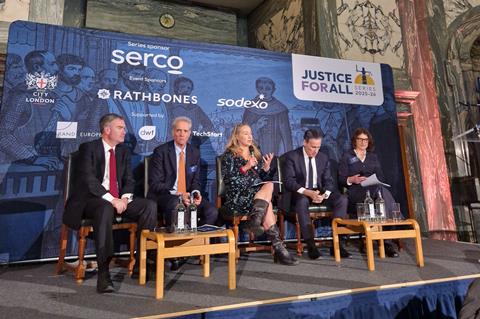
Judges and courts will need to be ready to deal with an AI revolution 'that may vastly increase the number of civil, family and tribunals claims', he said. 'We are already seeing that happening.’
The master of the rolls played down reports of fake authorities generated by large language model software, describing it as ‘pointless to dwell on…when we know that hallucinations are very likely soon to be things of the past’.
‘We need…to consider the more fundamental questions of how justice should be delivered when AI is able to decide cases, both civil and criminal, as or more reliably than humans and certainly far more cheaply and quickly.’
Humans would still need to be ‘front and centre’ of final justice decisions which affect people’s lives but he would assume individuals and businesses ‘are very likely, actively’ to want, at least minor disputes, ‘decided by machines, once they understand that such resolutions will be far quicker and cheaper than waiting for human judges to decide outcomes using outdated analogue processes and procedures’.
This article is now closed for comment.





16 Readers' comments