




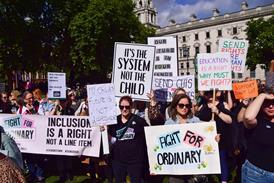

















The Crown court backlog has reached a record high of nearly 80,000 cases, according to official figures released today. However, deputy prime minister David Lammy said the latest data justifies his decision to curb jury trials – whereas the Law Society believes the data proves why Lammy’s proposals are a bad idea.
Criminal court statistics for July to September show that the number of outstanding cases climbed to a record 79,616. For the first time, the number of cases open for at least year has exceeded 20,000.
Lammy said: ‘The scale of this crisis means tinkering at the edges is not enough. We simply cannot spend our way out of this mess – only fundamental reform can give the brave survivors of crime fairer and faster justice.’ However, Law Society president Mark Evans said the figures demonstrate precisely why transferring more work from the Crown court to magistrates is not an effective option.
‘There needs to be a reduction in cases coming into the criminal justice system altogether rather than moving cases from one under-resourced part of the system to another,’ Evans said.
‘Many of the issues, which include prisoners not being delivered to court in time and courtrooms sitting empty, can be solved with funding and reform instead of headline-grabbing but unproven measures like cutting jury trials. There are no quick fixes. Only wholesale reform and investment across the entire system, as envisaged by Sir Brian Leveson, can bring down the backlogs and ensure swift and fair justice.’
Criminal Bar Association chair Riel Karmy-Jones KC said Lammy’s department could cut delays immediately by opening up more courtrooms: ‘It could make a difference today by giving key courts the extra funding that will allow judges to deal with their local backlogs, as is being done in Snaresbrook, and has been done in court centres like Liverpool, Preston, and in Wales… At the moment, available courtrooms are kept shut, and the prison population is being driven to breaking point - not with convicted prisoners, but with thousands of people accused, who are still waiting for their trials.’
Lammy told the justice committee this week that legislation for his proposed reforms, and impact assessment, will be published in the spring. He hopes his proposals will become law by the end of 2026.
This article is now closed for comment.





25 Readers' comments