






















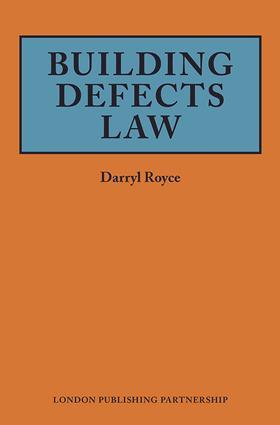
Building Defects Law
Darryl Royce
£125, London Publishing Partnership
★★★★★
Construction barrister Darryl Royce skilfully weaves case law into this toolkit for any practitioner who might be called upon to advise in relation to a suspected building defect – whether for a prospective claimant or a building contractor.
Having explained the founding common law principles relating to defective workmanship, the author looks at the way construction documentation is structured. He also considers how building work is guaranteed. Royce sets out in detail how printed form construction contracts, such as JCT, work in practice, and how building work is warranted. This includes the standard NHBC 10-year certificate, as well as collateral warranties and the Council of Mortgage Lenders-compliant Professional Consultant’s Certificate.
He then leads us through the Defective Premises Act 1972 and later changes to that legislation.
I particularly liked the way in which Royce provides an understanding of those standard contract clauses which we all take for granted. One example is the ‘Entire Agreement’ clause, which excludes representations or other extraneous terms, even if agreed during contract negotiations but not included in the final agreement. There is even case law about that.
In the wake of the Grenfell fire and the subsequent mass of legislative change, this book is one of the first to explain in detail and at a professional level how the Building Safety Act 2022 works, particularly as regards defective cladding.
Later chapters address the practicalities of bringing a claim for defective workmanship, with a focus on available remedies, including damages, specific performance and making an insurance claim.
Key to a successful claim for defective workmanship is getting the evidence. Royce addresses this in the penultimate chapter, which focuses on the protocols surrounding the use of expert witnesses.
V. Charles Ward is a senior property lawyer with HB Public Law






1 Reader's comment