























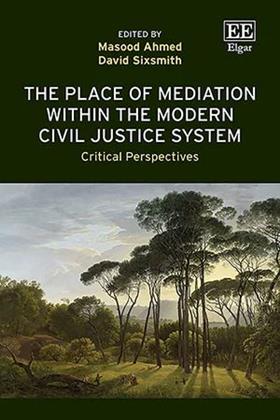
The Place of Mediation within the Modern Civil Justice System: Critical Perspectives
Edited by Masood Ahmed, David Sixsmith
£115, Edward Elgar Publishing
★★★★★
In the pantheon of excellent publications on dispute resolution in civil justice systems, this volume is essential reading for any lawyer, mediator and academic who is serious about ADR.
As counsel in two landmark cases in the Court of Appeal, namely Halsey v Milton Keynes General NHS Trust and Churchill v Merthyr Tydfil BC, it is gratifying to see such comprehensive and informed commentary on the development of ADR in general and mediation in particular over the last 20 years.
The chapter by Masood Ahmed on the changes in the English civil justice system as a result of those two decisions is one of the most incisive assessments that I have seen. In particular, he critically analyses an essential element of the Churchill decision which many commentators appear to have overlooked. That is the endorsement by the master of the rolls of what he described as ‘non-court-based dispute resolution procedures’. It was the rejection of and refusal to consider such a procedure by Mr Churchill’s solicitors which led to the decision by Merthyr Tydfil BC to appeal in the first place. The observations of Vos MR fully justified their decision – and provided a much-needed revolutionary approach to dispute resolution which was long overdue. Similarly, the chapter by Bryan Clark and Viktoriia Hamaiunova on the Singapore Convention is a paradigm of an expert evaluation of the importance and potential influence of that convention.
The collection includes fascinating comparisons with jurisdictions worldwide. The chapters on Turkey, China, Nigeria and Brazil are comprehensive. This is particularly gratifying for those established mediators who helped the development of mediation – through lectures and training seminars – in what were then considered as emerging ADR jurisdictions.
I found the discussion by Ben Wilson on ‘The History and Trajectory of Mediator Neutrality’ enlightening, and the list of rhetorical questions thought-provoking. Debbie De Girolamo’s survey of bespoke mediation for art works exemplifies the development of mediation as a means of resolving disputes in fields which traditionally were the subject of lengthy lawsuits, requiring the tribunal to evaluate the opinions of eminent experts.
Lastly, the chapter by Tony Guise with Victoria McCloud (retired Master of the High Court) evoked feelings of terror that the advent of ChatGPT will consign all practising mediators to history! Happily, the next mediation calmed those irrational fears and reinforced the need for a real human to empathise with another.
This book will accompany me on all future mediations. It is reminder that mediation is a resolution not a determination of people’s problems.
Michel Kallipetis KC, Quadrant Chambers, London
The Place of Mediation within the Modern Civil Justice System: Critical Perspectives
★★★★✩
The excellent foreword by Mr Justice Ritchie sets the tone for this fascinating and scholarly review of the application and use of mediation in England and Wales, as well as in various international jurisdictions.
Having first qualified as a mediator in the 1990s and then requalified twice in this century, I have to agree with Ritchie J that there is still a cultural hurdle to overcome for mediation to become part of our legal DNA. By exploring how mediation of civil claims can become a household tool, this work takes on a vast topic with elegance and focus.
The book is a genuinely good read. Each chapter explores the use and application of mediation from small claims to commercial disputes across the world – from British Columbia to China by way of Brazil, Nigeria, Holland and Turkey.
There is a retrospective review of the Singapore Convention on Mediation. This traces the main articles and considers the criticisms that have been made. The convention was clearly a landmark moment in mediation, but yet again demonstrates the slow uptake of this form of dispute resolution. As the authors note, the ratification process has been slow and more time needs to elapse in order to assess its true efficacy.
The uptake issue has been addressed by the mandatory mediation requirement in jurisdictions such as Turkey. Although born out of necessity due to huge backlogs, this raises the question discussed in this jurisdiction as to whether a mandatory requirement to mediate should be introduced before litigation can commence.
I had my eyes opened by the chapter on mediating art disputes, and was completely foxed by the deep dive into the digitalisation of mediation. I still enjoyed the excellent arguments and analysis.
This is a slim and thoroughly readable publication.
Susan Rodway KC is a barrister and mediator at 39 Essex Chambers








No comments yet