






















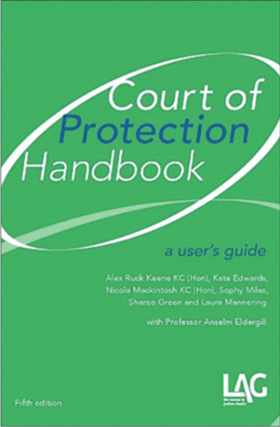
Court of Protection Handbook – a user’s guide (5th edition)
Alex Ruck Keene KC, Kate Edwards, Nicola Mackintosh KC, Sophy Miles, Laura Mannering, Sheree Green
£90, Legal Action Group
★ ★ ★ ★★
The Court of Protection’s much- delayed birth finally took place with the Mental Capacity Act 2005, with a late critical insertion addressing detention following an ECtHR decision. Previously, its current health and welfare functions were mainly dealt with by a combination of case law and common law. At the heart of its work lie critical best interest decisions for those vulnerable people who lack the mental capacity to make them.
The Court of Protection Handbook has followed the new court’s rapid growth step by step until this 5th edition. And as the editions have unrolled, so the book has received increasing judicial accolades.
There are many books which detail law and procedure in the CoP. However, what marks this study out is its general accessibility to both lawyers and non-lawyers alike. It covers the breadth of the CoP’s remit, from its longstanding work concerning property and affairs to the expansive areas around serious medical treatment. It considers the detention restriction of those in care homes, nursing homes and in the community; and the interaction with the Family Court for children who will have long-term mental disabilities. For such children, the CoP has recently been increasingly active, with those from the age of 16 coming under its jurisdiction. As family practitioners will know, the transition period from children’s services to adult social care is a difficult one. Frequent planning and resource issues arise as the child concerned hits the harsh reality of the stretched care and support provisions for adults. Recent judicial guidance has recognised this problem and brought many such cases into attended court for proper examination.
As one would expect from a jurisdiction springing from recent statute, there has been a welter of case law, directions and rule changes. Once again, these are dealt with, referenced and updated in the 5th edition, assisting practitioners and lay people alike. And once more, the reader is assisted by an accompanying online resource, which includes the provision of relevant precedents.
The lack of appropriate legal aid provision is well known, and certainly sharply felt by frustrated CoP solicitors explaining to an army of family members that they cannot get funding for legal representation concerning a loved one’s future. However, by referring them to this book, a solicitor can have some comfort that they have an invaluable tool in getting their voice heard.
Richard Charlton, director of Richard Charlton Solicitors, is past chair and president of the Mental Health Lawyers Association









No comments yet