






















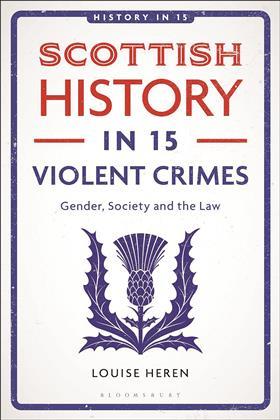
Scottish History in 15 Violent Crimes: Gender, Society and the Law
Louise Heren
£19.99, Bloomsbury
★★★★✩
This work is part of a new series of history books, each structured around 15 items that together tell a broader story – in this instance, the history of Scottish criminal trials told through 15 notable cases. The book examines not only the cases themselves, but also how they contributed to the evolution of criminal law and, more broadly, to the values and attitudes of Scottish society.
It begins with a potted history of the Parliamentary Union of 1707. The first case considered follows shortly afterwards: the 1709 trial of John Martin and his niece Elspeth for incest. The remaining cases proceed in chronological order, concluding with S v HM Advocate from 1989. They cover subjects including infant deaths, rape, same-sex child abuse, insanity, serial murder and the death penalty. The most famous – or infamous – case is probably that of Burke and Hare, tried for a notorious series of murders committed in order to sell bodies for medical dissection.
Inevitably, the book discusses attitudes and values that have long since been discredited, often reflecting scientific ignorance. Probably the most egregious example was the burning of Janet Horne for witchcraft in 1727. Yet cultural development, more so than scientific progress, rarely follows a linear path. Elspeth Martin was acquitted in 1709 because she had not consented (her uncle was convicted, meaning the jury accepted that the act had occurred), reflecting a recognisably modern approach to culpability in sexual offences.
By contrast, in S v HM Advocate, the defence advanced the manifestly unjust argument that rape could not occur within marriage. Scotland soon afterwards became the first country in the Union to remove that repellent anachronism from the criminal law – a reform the author describes as ‘the pinnacle of Scottish enlightenment’ – but it seems astonishing to modern eyes that the concept persisted so late into the 20th century.
The author concludes that, while developments such as the abolition of the death penalty represented progress, ‘the ultimate measure of… society’s advances is more probably its equal treatment of women’. Certainly, one sees from the book how the thread of sexual injustice has been woven through Scottish society for centuries, though it also shows how other demographic groups suffered prejudice and injustice.
There is much of interest to legal historians in this thought-provoking volume. Although the academic prose makes for quite a dry read in places, it is a stimulating work.
James Wilson FRHistS is the author of Lord Denning: Life, Law and Legacy (Wildy, Simmonds & Hill, 2023)








No comments yet