























Parole Board Hearings – law and practice (4th edition)
Hamish Arnott, Simon Creighton, Dr Laura Janes KC
£55, Legal Action Group
★ ★ ★ ★✩
A significant amount of legal work takes place beyond trial preparation, extending well past conviction and sentence when a case results in custody. Much of this diligent work continues throughout the parole process. It is widely recognised that many who persevere in this area do so out of principle. Its importance cannot be overstated, nor its complexity underestimated.
This is a highly technical field of law that has undergone substantial change – particularly over the past five years – with a renewed emphasis on transparency.
Hamish Arnott, Simon Creighton and Dr Laura Janes KC’s book is now in its fourth edition since it was first conceived in 2006. Their 429-page study is a handy and comprehensive guide.
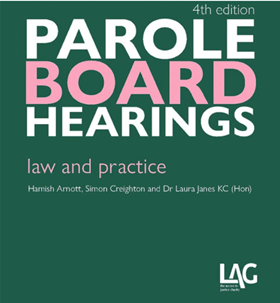
The book is divided into 12 chapters, which deal with and demystify every stage of the parole hearing process, including the scope of public funding available. At the back, the reader is able to access the ‘Parole Board Rules of 2019’ as well as ‘Release and Recall of Life/Indeterminate Sentenced Prisoners as defined by the Crime (Sentences) Act 1997’.
The original authors are joined in this edition by the contribution of Janes, a consultant solicitor best known for her work at the Howard League for over 16 years. As the current chair of the Association of Prison Lawyers, she has shared her knowledge to help update a work last published 12 years ago. The book also draws on information and insights shared by those working at the board and the Ministry of Justice to ensure that it remains practical and up to date.
Chapter 4 focuses on risk assessment, which lies at the heart of the process. The board acknowledges this to be an ‘imprecise science’ and one which seems to be the area most ripe for contention and challenge. The reader is guided through each assessment tool, with the authors providing clear and thoughtful explanations throughout.
Chapter 8 focuses on the oral hearing procedure. It offers reassurance both to those approaching the process for the first time and to practitioners who may feel out of practice and wish to revisit the key stages of the hearing.
This book should not be regarded as a resource for lawyers alone. It will be equally valuable to probation officers, prisoners and those offering advice in law clinics. It is precisely the kind of work that proves indispensable.
Steven Ball is a barrister specialising in crime, and practising at Red Lion Chambers in London and Chelmsford







No comments yet