






















Statutory Nuisance: law and practice (3rd edition)
Rosalind Malcolm and John Pointing
£150, Oxford University Press
★ ★ ★ ★ ★
Since my early days in practice, I have always found statutory nuisance to be a deceptively complex corner of environmental and public health law. I have never found it to be a straightforward local authority function under the Environmental Protection Act, and I quickly discovered a dense web of case law, procedural nuance and evidential challenge. I often found it difficult to find a guide that combined doctrinal rigour with practical utility, so I was pleasantly surprised by this book.
This third edition meets that complexity head-on. It is both an authoritative statement of the current law and a genuinely practical guide for those required to apply it in real-world settings.
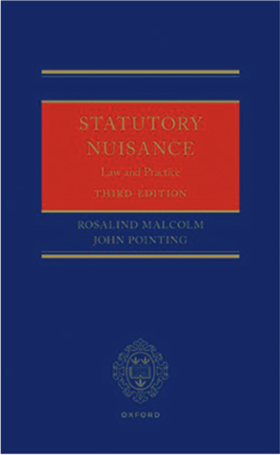
The book begins with a clear exposition of the statutory framework, grounding the reader in the historical development and policy rationale of the regime, before moving into a detailed consideration of the various categories of nuisance. The authors demonstrate a thorough command of the case law, but what impresses most is their ability to distil principle from authority without overwhelming the reader. The analysis is careful and measured, never straying into unnecessary abstraction. The book further highlights the importance of ensuring that statutory schemes do not undermine public protection, and discusses the role of local authorities and courts in maintaining this balance.
Particularly valuable is the treatment of procedure. Other books devote disproportionate space to substantive definitions, while giving limited attention to the mechanics of application. Here, the procedural chapters do the opposite – they provide clear guidance on evidential thresholds, drafting considerations and strategic decision-making.
The analysis of defences and appeals is thorough, identifying inconsistencies within case law, examining the development of legal principles, and highlighting areas where the law remains uncertain. The commentary on the interaction between statutory nuisance and other regulatory regimes is also timely, reflecting the increasingly layered nature of environmental control.
Recent cases are fully integrated into the text rather than appended. The footnoting is thorough but never intrusive, and the referencing allowed me to trace arguments back to primary sources with ease. I am now even more equipped to anticipate and manage litigation risk.
Zainab Zaeem is director/solicitor at Summerfield Browne Solicitors, Leicester








No comments yet