





















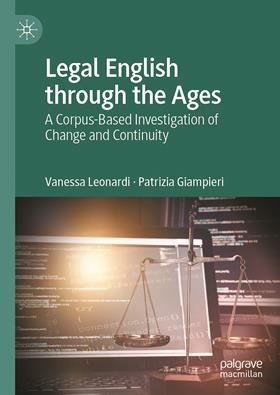
Legal English through the Ages: A Corpus-Based Investigation of Change and Continuity
Vanessa Leonardi, Patrizia Giampieri
£109.99, Palgrave Macmillan
★★★✩✩
I have been trying to arrange a ‘protected conversation’ meeting for a client to discuss settling a case, strictly on a without prejudice basis. I could just have said: why not have a roundtable discussion, or a quick off-the-record chat? All, or most of these expressions, have a precise legal meaning. But why do I add the words ‘strictly’ and ‘precise’? Arguably, they do not add anything because it is either privileged or not, and legal meanings are exact.
This book is about the language we use as lawyers and the developments in technology which allow research into its use. If AI is used to generate and then analyse legal documents, such as reading a contract, will it use legalese or everyday language?
The authors argue that legalese is a barrier to education. Many students have to learn English as a second language, and studying everyday language is challenging enough without adding another terminology. The second argument is that laypeople do not understand legalese. I am unconvinced. Foreign students will have to learn technical terms and euphemisms relating to any profession. Moreover, people expect formal language when dealing with a profession.
Occupations have their own lexicon. My car had a manifold, distributor and exhaust, all words with precise meanings borrowed from general use. The word ‘manifold’ is archaic in general use. When I go to church, I am a layperson, but the next day, when at work, I am not. Should you say layman and laywoman or layperson? The third member of most tribunals is no longer referred to as ‘lay’, as it was thought archaic, ecclesiastical or confused with ‘lay’ in other senses. Using different words and phrases adds gravitas.
This book contains a history of legal language from classical times, including Roman influence on English law (which in some ways was minimal). Latin words and phrases were retained. We did not persist with Roman law but adopted Anglo-Saxon, Norse and Norman law. ‘Law’ is a Norse word. Norman French was used in legal documents, parliament and courts until well into the 18th century. Lawyers had to speak law French, which was a curious combination of English and French.
I recall the purge of ‘old-fashioned’ legal words in the 1990s when plaintiff became claimant, writ became claim form, and discovery changed to disclosure of evidence. But lawyers tend to rely on other words in documents that are not used in everyday speech, such as herein, witnesseth, aforesaid and whatsoever. There has been an excellent campaign to simplify public forms; there are also very good books on simple but clear English for lawyers.
Another area for study, not in this book, is the coded language used in court. An example is asking a judge for a few minutes with the client or saying you are instructed to apply for bail.
The case for clarity is, prima facie, a good one.
David Pickup is a partner at Pickup & Scott Solicitors, Aylesbury






No comments yet