






















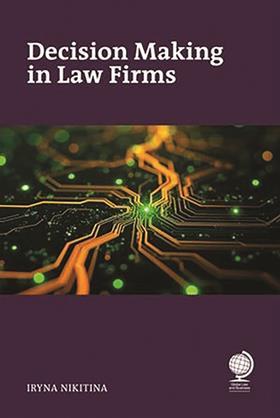
Decision Making in Law Firms
Iryna Nikitina'
£159, Globe Law and Business
★★★✩✩
The author observes that there is plenty of academic writing about leadership in general, but ‘a glaring gap when it comes to legal partnerships’. She uses her experience of working with law firms – and a solid academic understanding of management theory – to produce this practical guide.
Nikitina considers five main types of lawyer: the rational (who needs data and logic); the intuitive (who relies on pattern recognition); the dependent (who always looks for consensus); the avoidant (who delays making decisions for fear of adverse consequences); and the spontaneous (who wants to take a quick decision, then adapt on the fly). But it is not as simple as that: we apparently all have a dominant and secondary ‘type’. Decisions are best made by combinations of people who have different types.
The author does more than discuss personalities. She also considers structural issues in firms that affect decision-making, including what are the firm’s stated and unstated values, and the different ways in which partners develop a consensus.
As a sceptical lawyer, this reviewer went through several stages in considering this book. His first instinct was to seek data on the author: who is she and what are her credentials? From looking at her LinkedIn profile and website, he gathered more information than was given in the book itself. It appears that she is based in Bulgaria and has worked for clients in ‘four continents’.
After reading a chapter or two, he became more inclined to listen to what the author had to say. Some of her comments resonated with him, such as how different personality types deal with a toxic but successful partner – a very difficult issue that he is aware of from discussions with friends in other firms.
The next stage of his rumination was: which legal personality types would actually read and obtain benefit from this book? He found some parts more interesting than others, but perhaps this is just his natural impatience coming out. He wondered whether other personality traits that are not the central focus of the book might play a role in decision-making – for example, patience/impatience, ego/selflessness, aggression/mildness, and whether one is an extrovert or introvert.
Consider the example of a successful, mid-sized London law firm, whose managing partner built the firm over many years. After he retires, there is no obvious successor and the partnership decides to appoint a pair of managing partners. What combination of personality types should the partners look for to optimise the chances of future success? An intuitive with a dependent? Or a rational with an avoidant? The author considers different combinations and their strengths and weaknesses. There is no single, right answer; it depends on the circumstances.
Is a more fundamental restructuring required to suit the personalities and aspirations of the remaining partners? For example, if the firm previously relied on a dominant personality – and many of the partners are followers rather than leaders – should there be a ‘ground up’ restructuring of how the firm makes decisions?
When this reviewer started in practice, he was introduced to the idea of lawyers falling into three categories: finders, minders and grinders. This could be viewed as a rudimentary version of the type of analysis that the author lays out. In the above example, the partnership now has lots of minders and plenty of grinders among the associates to do the work. It could probably survive for years, keeping existing clients happy. But where are new clients and lines of work coming from? Should the firm hire some finders? And, if so, how would they fit within existing partnership values and norms?
The firm may muddle through, evolving over time. If the firm has a strong reputation among clients and plenty of work, change may only occur when younger partners start to take charge. But that may be too slow an evolution in a fast-moving market.
The author considers similar issues based on her analysis of how firms work. You might read the book carefully and work out the best way to develop the decision-making in your firm – though perhaps you need to persuade all your partners to read it too, in order to draw similar lessons.
Mark Anderson is chairman of Anderson Law LLP, Oxfordshire









No comments yet