























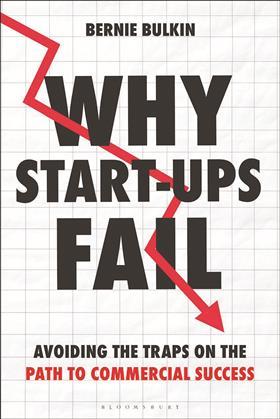
Why Start-Ups Fail: Avoiding the traps on the path to commercial success
Bernie Bulkin
£25, Bloomsbury
★★★★★
I have been writing about tech start-ups since 2015 – and it was refreshing to read an honest account from an investor’s perspective, especially since AI has brought unprecedented levels of investment to tech. Bernie Bulkin is a scientist, economist, business leader and start-up investor who brings a lifetime of experience to the table.
The truth is, while there are more start-ups in the UK than ever, and some of them are spectacularly successful, many are forced to pivot and most of them fail. Many successful entrepreneurs have had more than one venture fail before finding one that works.
This book is actually a guide to making your start-up succeed – or at least convincing investors to back it. The first six chapters are also a guide for potential investors, as they offer important and not always obvious questions to ask at pitches. Of course, the work is mostly directed at founders, in terms of what to expect, and more importantly, to work out whether their product is market-ready and investible, and how to put themselves in a strong position to pitch to investors.
While the format is a bit like a textbook, with key learning points and footnotes at the end of each chapter, it is well-written, crisp and pragmatic.
Most of the book examines six main causes of failure and sets out the key questions an investor should ask in order to identify red flags. It also considers how a founder should address these issues before they become serious. The first issue is technology that does not work. While that seems obvious, in today’s world of tech and AI, it isn’t necessarily. Many tech products go to market as a proof of concept that may or may not be scalable or enterprise-ready – and that can make the difference between success and failure.
Next comes market forces (which I would have put first). Even if the product is good, will anyone buy it? Is there a gap in the market, or is it something that people do not need/want enough to pay for? Is the company investible? Everyone wants reliable products – and skilled engineers.
The last three challenges concern general business competencies and management skills: make sure you have the right leadership, the right board and enough money. These are grouped together at the end as critical success factors. Leadership is key because, as Bulkin observes, investment follows confident leadership more than any other factor. Yet transitioning from founder to leader is a major shift. Because people follow a leader, the choice of leader is business-critical. It is not necessarily the chief technology officer, who tends to be the person who built the product in the first place. As a start-up grows into a more corporate entity that requires governance, the board needs to evolve with it. The sixth cause of failure is, of course, money.
The final two chapters, which were clearly designed to pick up any loose ends, did not have the same crisp structure as the rest of the book. The shift to a more rambling style made the book challenging to read in one sitting. However, it’s still a great start-up guide to dip into for would-be entrepreneurs, angel investors and anyone engaging with the start-up ecosystem.
Joanna Goodman MBA is a technology journalist









No comments yet