























McMeel on the Construction of Contracts: Interpretation, Implication and Rectification (fourth edition)
Gerard McMeel KC
£225, Oxford University Press
★★★★★
I cannot remember when I attended my first lecture on contract law. I think it must have been an autumn Tuesday morning in a run-down London lecture theatre. No handouts in those days – just the distinguished lecturer’s words, which students scribbled down in longhand.
I was reminded of my first attempts at gaining knowledge of contract law when reading Gerard McMeel KC’s eponymous McMeel on the Construction of Contracts. Student contract law is all about offer and acceptance, consideration and discharge, all flowing in a neat chronological fashion. Things change, though, as you move from theory and training into practice. Whether as draftsman or litigator, it is the meaning of words that often forms the battleground between contracting parties. McMeel takes on that difficult task of applying an in-depth scholarly analysis to contemporary problems in contract, but at the same time has produced a work that has real practical application.
The question of how certainty can be balanced with doing justice has been a feature of contract law since the days of Lord Mansfield, if not before. The interpretative task that is necessary for that balancing act could, I suppose, be boiled down to a simple question of what words mean and how they should be understood. As the author points out, quoting the US scholar J H Wigmore, some might conclude that contractual interpretation has moved from ‘stiff and superstitious formalism’ to ‘flexible rationalism’. But the existence of the two schools of interpretation – literalist versus purposive – remains a constant. Some interpretative exercises fall squarely into one camp, only to be explained away in later decisions by opposing views and confined to the semi-dustbin of obiter dicta. To those taking on the challenge of this fascinating area of law, McMeel offers a reliable guide.
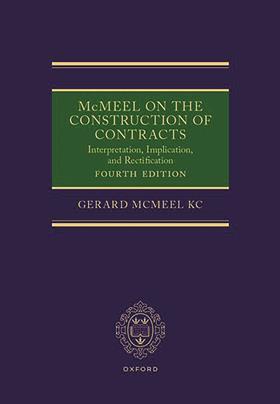
His study takes a different structural approach to contract law than the one a reader might find in standard texts. Instead of a broadly chronological approach to contracts – how they are formed, what is in them and how they end – this work is split into five discrete but complementary parts. At 367 pages, Part I – the ‘General Part’ – is a substantial work, and more than just an introductory essay. It tackles the development of contractual construction and gives the reader a solid understanding of the issues and principles in play. Part II looks with even more depth into the implication of terms, relational contracts, and rectification. Parts III and IV focus on particular contractual provisions, and the problems that flow from the interpretation of written documents. The work concludes with a rundown of the techniques available for the resolution of disputes through the civil courts.
The General Part gives the reader, regardless of their specialism, an overview of those principles that govern contractual interpretation. Taking a broader perspective in this way helps give context to the specific analysis of the topics that follow later. It also helps frame and explain contractual interpretation being confined to the meaning of words, and contractual interpretation going beyond the words in a document and putting them in their context. I found the overview of 12 leading decisions of the House of Lords and the Supreme Court particularly thought-provoking. Taking us from Prenn v Simmons [1971] 1 WLR 1381 (and I do not recall that case being considered as significant when I first started studying contract) to Arnold v Britton [2015] UKSC 36, gives the reader a real sense of the development of contract law. Arnold, though, is not without its critics, some considering it wrongly decided. Conversely, Lord Sumption, extrajudicially, has taken an opposing view and considered Arnold definitive. The author guides us skilfully through this debate and the possible resolution through the words of Lord Leggatt (again extrajudicially). The treatment of text and context in Wood v Capita Insurance Services Ltd [2017] UKSC 24 – which has acquired the status of the last word on the subject – is also covered.
Part II gives an excellent account of the rise of the implied term. The idea of the implied term can be a bit of a chimera at times. In some contexts, there is not so much an implication of a term but an imposition through the action of the law, such as the minimum periods of notice provided by the Employment Rights Act 1996. Perhaps the terminology adopted in McMeel is standard now, but I do not remember as a student being taught that a term implied in fact was an exercise in judicial gap filling. ‘Gap filling’ is much easier to understand than the opaque ‘terms implied in fact’ formulation.
It was to aid such judicial gap filling that the officious bystander was conjured up by Lord Justice MacKinnon, to help perpetuate a fiction that the judge is merely discovering what the parties had originally intended.
This concept of an officious bystander having a walk-on part was first set out in a lecture by Sir Frank MacKinnon at the LSE in March 1926, and then recycled in his judgement in Shirlaw v Southern Foundries (1926) Ltd [1939] 2 KB 206. Even though now a centenarian, the officious bystander has proved to be remarkably robust, surviving attempts at assassination by no less a judge than Lord Denning (in Liverpool City Council v Irwin [1976] 1 QB 319 – saved by resuscitation in the House of Lords: see [1977] AC 239) but still attacked again by Lord Hoffmann in the South African Law Journal, who dismissed the officious bystander as ‘a vivid bit of pantomime’. Finally, Lord Leggatt most crushingly has the officious bystander leave the stage as a colourful but unhelpful thought experiment.
That last dismissal of the aging officious bystander was in Tesco Stores Ltd v USDAW [2025] ICR 2024. This is interesting on many levels. Collective issues between trade unions and employers have not until recent years been the subject of contract-based litigation. Section 179 of the Trade Union and Labour Relations (Consolidation) Act 1992 makes collective agreements binding in honour only unless the parties agree to the contrary. But in Tesco it was the union using the courts and contract to win an argument that an implied term could remove the employer’s power to terminate the contracts of workers with retained pay. Litigating the point at all speaks volumes for the change in attitudes, both of the courts to trade unions and the trade unions to the law.
Part III focuses on particular construction problems in relation to specific clauses, such as indemnities and warranties. Part IV then goes on to look at matters through the focus of purely written instruments, with a handy résumé of forensic issues to guide the user through court process specific to disputes over interpretation.
Textbook writing is of course a little like painting the Forth Bridge: as soon as you finish and the ink is hardly dry on the galley proofs the task starts all over again. The next edition may need to deal with the problems of meanings in contracts set out not in ‘natural language’ but in computer code. Will a future edition need to consider not the officious bystander, but what the reasonable coder may have to consider in respect of the parties’ intentions? Even with, or perhaps especially because of, the rise of AI, we need work like McMeel more than ever.
Max D Winthrop is a partner at Sintons LLP in Newcastle








No comments yet