






















Judicial Review: Principles and Procedure (2nd edition)
Jonathan Moffett KC, Jonathan Auburn KC, Andrew Sharland KC
£325, Oxford University Press
★★★★✩
In Henry VI, Part 2, Shakespeare imagines a dialogue between rebel leader Jack Cade and his henchman Dick the Butcher. As they fantasise about the actions their proposed regime will take, Dick suggests: ‘The first thing we do, let’s kill all the lawyers.’
Dick has a point. One of the first objectives for Cade’s regime would be to crush resistance – and the law and its practitioners are at the forefront. Lawyers – especially those in oppressive regimes – have the awkward habit of pointing out where the government is acting in breach of the law, undermining its moral and legal claims to legitimacy. Even in liberal democracies such as the UK, lawyers hold government to account. Democracy and the rule of law depend on a fearless and independent legal profession, willing to stand up to power and argue for citizens’ rights against the state.
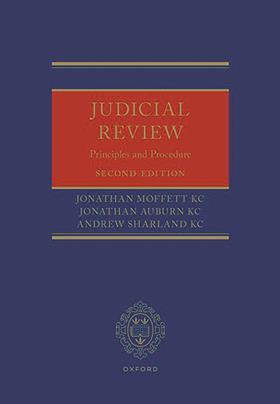
Judicial review is a cornerstone of the constitution, so any work that sets out the principles in a clear, accessible and practitioner-friendly way is a good thing.
Intended as ‘a guide to the law and practice of judicial review, written by practitioners for practitioners’, this work meets that objective. It is well-structured, providing a detailed but user-friendly overview of procedure and key principles, such as the interaction of domestic JR with supranational systems such as the European Convention on Human Rights, public international law, and the surviving points of contact between UK and EU law.
The analysis of the substantive grounds sub-divides them into procedural and substantive categories, making for a more logical approach than the usual classification of ‘illegality, irrationality, and procedural impropriety’. The substantive law is thoroughly but practically treated. Given the complexity of public law in the aftermath of Brexit and fast-changing case law in relation to human rights and ‘common law constitutional rights’, such a thorough yet succinct treatment is no mean feat. The indexing is clear enough to make searching for the relevant information relatively painless.
Very much a text for specialists – at over 1,700 pages, and a price north of £300, it is not one for general readers. Nevertheless, this is a useful single-volume work, ideal for experienced practitioners and those developing their knowledge.
James E Hurford, solicitor, London









No comments yet