























‘You felt the dignity and the modesty of the man… His voice was a symbol of what all civilised people want and mean by justice – something serene and unafraid and stronger than time. Something that will endure in honour.’
It was a careful voice. Quiet. Not hasty.
US journalist Martha Gelhorn’s description Lord Justice Geoffrey Lawrence, president of the Nuremberg Tribunal, in her account of the defeated German leadership’s war crimes trials, hasn’t left my head since I read it as a sixth former in 1990.
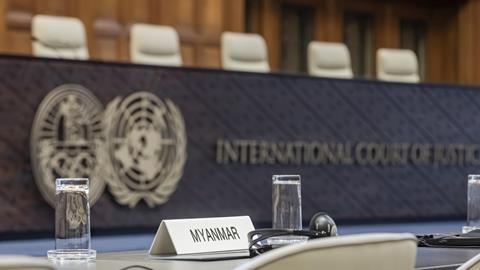
As the world’s legal and political community reviews the judgment of the International Court of Justice (ICJ), that Myanmar as a state has committed a genocide against its own Rohingya minority population, it’s worth reflecting not just on the importance of international justice, but also what such trials are, and what they are not.
And Gelhorn had a lot to say that was relevant.
First to the wilder claims and counter claims that followed the ICJ’s judgment.
Well, there’s right-leaning thinktank Policy Exchange, whose own press release was so quick out of the stocks today, that one suspects they weren’t wading through the judgment before pressing ‘send’. The judgment took several hours to deliver, weighing in at 191 pages. Even the press release is six pages long.
Policy Exchange wheeled out retired diplomat Sir John Jenkins to say: ‘The judgment of the International Court of Justice today could expose British Ministers, officials and Armed Forces to increased legal risk of malicious accusations of genocide. Our history, our allies and our Armed Forces could all be in the firing line.’
Sir John, who is not a lawyer, is a ‘senior fellow’ at Policy Exchange. It’s fair to say the thinktank has a bee in its bonnet about people crying genocide too easily. ‘Accusations of genocide are now made, without justification, against the United Kingdom, France, and others.’
At the other end of the spectrum, are people who now enthuse that Israel can be ‘done’ for genocide in Gaza following the ICJ judgment. Yet another group seems outraged that the ICJ has handed down a judgment concerning the Rohingya before focusing on Palestinians in Gaza. (This, despite the latter conflict being the more recent.)
Where to begin with these responses?
To start, Nuremberg handed down capital sentences. Despite being dubbed the world’s apex court, the ICJ lacks enforcement powers. It does though define appropriate remedies.
In Myanmar’s case, the court stated that to comply, Myanmar must cease ‘ongoing violations’ of the 1948 Genocide Convention; investigate all individuals reasonably suspected of violations under the convention; provide assurances of ‘non-repetition’ of violations; organise for a ‘dignified return’ of those displaced; and pay compensation to those affected.
Myanmar has two years to do this. But the court has no sanctions it can apply for non-compliance with its judgments. Chances on compliance by Myanmar are slender.
Read more
So why bring a case to the ICJ?
It is more than symbolism – the ICJ’s jurisprudence can shape that of other courts. The government of Ukraine’s ICJ cases against Russia build the legal case for confiscation of Russian assets, and are regarded as significant, albeit international legal redress is a long game.
Despite Policy Exchange’s bluster, Philippe Sands KC, one of several counsel who appeared for Gambia, which brought the case against Myanmar, was been very clear today on what the case does and does not do.
Although it is the first time a finding of genocide has been made against a nation state, there is no new law here.
The difference, Sands told the BBC lunchtime news, was the depth the court had gone into during the case, allowing it to make its headline finding with confidence. That may be a new standard the ICJ will work to in future. The finding of genocide against a state is a ‘first’, but it is not new law. The chief novelty here is greater diligence on the role of a state in the crimes reviewed.
The judgment is standalone and specific to the facts of the case. This is a point on which the court has been quite clear. It is not (my phrase) a product to be white-labelled for use in a future case against the UK or France. Or Israel.
In fact, every case that has determined charges of genocide and war crimes has been a standalone event. Nuremberg, Tokyo, Yugoslavia, Rwanda, Lebanon and the Khmer Rouge tribunals were all ad hoc courts, specially created for their defined purpose.
The International Criminal Court is a bold attempt at a standing forum which indicts individuals, but there are strict limits on its jurisdiction which its opponents generally fail to acknowledge.
Some such tribunals might learn lessons from predecessor courts, but it’s not a given.
Planning is case specific
‘Planning and preparation are essential,’ Gelhorn wrote, and to establish they were done in order to effect what followed is an essential test that must be met to prove a charge of genocide. In this context, as Gelhorn observed ‘the state is not some vague abstraction’. Planning and preparation leave a trail of evidence that is specific, and not to be generalised.
So perhaps the bluster from those who dislike the ICJ’s finding of genocide against a state does not stem from a fear of a brand new general legal principle. Instead, I suspect that the fear is that one day, a court or tribunal may be in a position to get into the weeds of their own case-specific planning and preparation.
To read in the case against Myanmar, for example, ‘the evidence from numerous locations [which] establishes deliberate executions, indiscriminate shootings, killings at riverbanks and of persons injured or captured, shooting of those attempting to flee, burnings, and killings of children and infants’ is to understand what Gelhorn knew when she wrote: ‘You… felt inside yourself such outrage that it choked you.’
For Myanmar and the Rohingya people, one knows what happens next, following the ICJ’s genocide finding. But reviewing the evidence of the crimes set out before the court, I’m clear in my mind that any accountability for their commission and execution, in a fair forum whose determinations are based on evidence, is a good thing.
The ICJ’s full judgment can be read here: Judgment of 19 November 2026
Martha Gelhorn’s 1946 article for Collier’s Magazine can be read here: Nazis on Trial (Collier’s Magazine, 1946) – Old Magazine Articles













No comments yet