

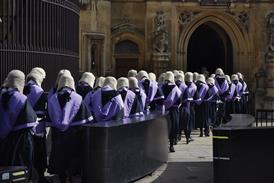





















The legal profession has never looked more diverse. But look beyond the point of entry and the picture changes.

Black pupils now make up 5.7% of those starting at the bar, slightly above their share of the working-age population. Among trainee solicitors, around 4% identify as black.
There are landmarks at the very top, too. In 2025 Barbara Mills KC, then a recorder and deputy High Court judge, became the first black person to chair the Bar Council in its 130-year history. This year she was named a life peer, and is now Baroness Mills of Greenwich KC.
But progress through the profession has not kept pace with progress at entry level. Black barristers make up 3.9% of the junior bar but just 1.2% of King’s Counsel. Only eight black women are KCs in England and Wales. In 2025, the year of the Bar Council’s first black chair, a record 10 black barristers applied for silk, and none was appointed. The following year, 11 applied and two were appointed.
In the largest law firms, those with 50 or more partners, just 0.5% of full-equity partners are black. Put plainly, at those firms roughly one partner in 200 is black.
This progress also comes when diversity work itself is under attack. For many black professionals, the result is a kind of intellectual stop and search: a demand, spoken or otherwise, to produce evidence that they earned their place.
Talent has never been the missing ingredient. Access is.
Careers are built through opportunities: the difficult brief, the important client, the chance to be led, the recommendation made when you are not in the room. Sponsorship matters because talent alone is not enough if those opportunities do not follow.
Breaking the glass ceiling requires individuals to excel at their craft with a razor-sharp focus on their mental health to maintain resilience and sustain a career long-term. That is only half the picture, because those qualities must meet opportunity at every junction, and thrive in a system that offers a fair and equitable distribution of high-quality complex work and earnings.
'Black judges remain just 1% of the judiciary. Because tomorrow’s senior judges will largely come from today’s KCs and senior solicitors, today’s gaps will shape tomorrow’s bench'
A representative profession also matters in the courtroom. While racial bias is widely discussed in criminal justice, its presence in family law and care proceedings carries equally life-changing consequences for children and parents. Black children are over-represented among looked-after children, and black and Asian children are subject to deprivation of liberty and secure accommodation orders at more than twice the rate of white children.
No one needs to share a family’s heritage to represent or judge them well. But everyone involved needs to recognise when their own experience is shaping what they regard as normal. Multi-generational care arrangements, or children calling community elders ‘auntie’ and ‘uncle’, can look very different depending on the cultural lens through which they are viewed.
Black lawyers in senior positions matter for another reason. Decisions about who gets the career-making case, whose name is put forward, who is introduced to an important client and who is seen as ready to lead do not happen in a vacuum. The more varied the experience around those decision-making tables, the more likely that talent will be recognised beyond the usual networks and familiar faces.
It matters to the public too. Diverse representation does not guarantee confidence in justice, but persistent absence can undermine it. When a parent enters a courtroom and sees no one who looks like them, it can reinforce the belief that the system works against them rather than one in which they have an equal place.
Black judges remain just 1% of the judiciary. Because tomorrow’s senior judges will largely come from today’s KCs and senior solicitors, today’s gaps will shape tomorrow’s bench.
What should change now?
First, follow the work. Chambers and firms should record who gets the important cases, the led work, the valuable clients and the opportunities that build careers. If the same people repeatedly miss out, ask why.
Second, make sponsorship part of leadership. Senior lawyers should not simply advise talented black juniors; they should recommend them, introduce them to clients and put them forward for opportunities.
Third, set measurable targets. Chambers and firms should set and publish one-, five- and 10-year targets for recruitment, retention and progression into senior roles and report on whether they have met them. If we are serious about ensuring the profession looks like the society it serves, we need to know who is applying, who is being shortlisted, who is being appointed and where the gaps remain. Transparency and accountability are key.
A more diverse intake is a start. Equality is measured by who is still there, and where they are, 20 years later.
Baroness Mills of Greenwich KC (Barbara Mills), Andrew Powell KC and Bibi Badejo are barristers at 4PB, London









No comments yet