




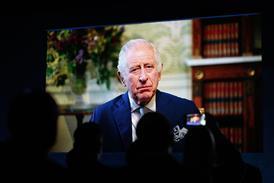

















Last week, I attended an event at the Law Society to gaze into the future. This is good, even if it is impossible to say what will happen tomorrow, let alone in 2040.

We know that futurology is neither a science nor exact. Although the fate of Greenland was mentioned in passing, the event took place before the tariffs on the UK and other European countries were announced by President Trump at the weekend, as punishment for European support for the status quo in Greenland – and before whatever else will come to pass after I have written this article.
As many others have said, a geopolitical split between NATO allies seems a significant turning point in our fate. Not surprisingly, if carried through to implementation in one way or another, it will have an effect on legal services.
My reflection after last week’s Law Society event is that the assault on globalisation by the Trump administration has so far had an effect on the globalisation of goods, but has passed by trade in services almost altogether, including in legal services. There are doubtless various reasons for this.
First, President Trump comes from a background in goods, albeit of the immoveable variety, and so his negotiations have tended to concentrate on what he knows and can see.
Second, whereas goods can be stopped on the ocean, diverted to the US, blown up by the military, and easily taxed on arrival in a US port, services are intangible. They are much more difficult to regulate, to the point of impossibility when virtual. Yes, lawyers can be stopped at the airport and refused entry, or deported if already present in the US, but virtual legal services which sail through the ether are almost impossible to catch.
That is why the globalisation of legal services has continued to thrive despite the political turmoil. That is why I also believe that the provision of international legal services will survive in nearly every circumstance in the foreseeable future.
Read more by Goldsmith
Let us assume the worst, and that we will soon be grouped into large and hostile geographical blocs like America, China and Europe. I assume that, despite Brexit, we will cast our fate in with Europe. There will still need to be dealings between the blocs: there will be trade, there will be disputes, there will be people and businesses whose circumstances cross borders between blocs. International legal services will be reduced, maybe substantially, but there will still be a need for them.
UK lawyers may be particularly susceptible to damage from the changes. That is because our success has depended so largely on the widespread use of English law and its resolution in English courts and arbitration. I assume that the new hostile blocs will take action to prevent businesses from using the law or dispute resolution services originating in another bloc, however good those services may be. Lawyers in the American sphere will be obliged to use US law and arbitration, lawyers in the Chinese sphere the Chinese equivalents, and so on.
The big law firms will suffer in another way. There will surely be pressure on those law firms which are currently alliances of law firms from different blocs, to split up to limit cross-border cooperation. There have already been pressures on law firms in the much easier current climate: for instance, the Dutch Bar, following the executive orders issued by the US president targeting law firms, issued a memorandum stressing that Dutch lawyers must act without interference from the government, and that they should not make promises or agreements that compromise independence in relation to clients or cases, including on diversity, equity and inclusion.
So, there may be big potential changes ahead, but I predict they will not be fatal to the sector.
However, legal services should not be considered in isolation from other likely changes. I said that services had so far been nearly completely unaffected. But they have been impacted, and it may grow worse. US tech services, for instance, have been weaponised through the use of sanctions against international officials of whom the Trump administration disapproves, principally at the International Criminal Court in The Hague. And hostile actions have been threatened if US tech firms are regulated or taxed outside the US against the wishes of the Trump administration.
In the scenario of hostile blocs, it is likely that Europe – and so our law firms – will be thrown back onto the use of European tech, which is, to put it politely, nascent. That would cripple our competitivity, and set us back years.
Oh George Orwell – in ‘1984’, there were three blocs, and you saw us belonging in Oceania along with the United States. But it seems as if we will be in Eurasia after all. However, for the rest of it, your vision seems to be coming along nicely.
Jonathan Goldsmith is Law Society Council member for EU & International, chair of the Law Society’s Policy & Regulatory Affairs Committee and a member of its board. All views expressed are personal and are not made in his capacity as a Law Society Council member, nor on behalf of the Law Society









2 Readers' comments