



















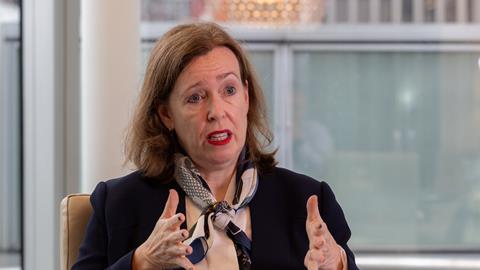
Sarah Rapson succeeded Paul Philip as chief executive of the Solicitors Regulation Authority last November. So what has this high-flying public servant learned in her first 100 days?
New SRA boss Sarah Rapson tells the Gazette’s editor-in-chief Paul Rogerson about her early impressions of a watchdog which many lawyers believe needs a radical reboot.
Paul Rogerson: This is hardly the cushiest job in regulation, especially at the moment. Why did you want it?
Sarah Rapson: I thoroughly enjoyed being supervision director at the Financial Reporting Council [professional regulator for accountants], and helping that sector improve things like audit quality, and its resilience and professionalism. Accountancy is also a profession grounded in ethics and integrity. There are many parallels with the SRA in that respect. I enjoyed being at the Financial Conduct Authority as director of authorisations for the same reasons. Regulation, if done effectively, can make a real-world difference for the profession, for the firms and for the market that is regulated.
Also, given my background in dealing with tricky, politically sensitive issues, I think my skills are relevant for what we need to do here at the SRA.
PR: So you’re used to select committees and the like?
SR: Yes, I did 13 at the Home Office! I must have been there every two or three months for a three-year period. And I’ve worked closely with government ministers.
PR: What about your management style? I’ll put this in a slightly provocative way. How are you going to differ from your predecessor Paul Philip in the way that you run the SRA?
SR: That’s a good question. I bring a deep expertise in operational delivery, plus the experience of being at other regulators and around government. When I’ve been out and about, I’ve been listening really hard to what people have been telling me about the SRA. There are some early priorities for me that I’d like to talk about.
PR: So what have you been told?
SR: One of the key messages – and one of the things I’ve been trying to do – is for the regulator to be open and engaged, and to talk directly with the regulated community and other interested stakeholders. It’s quite a busy landscape for people who’ve got a view on how the SRA and the legal services market should operate. I think being open and willing to listen, and to shift our approach if we need to, is a really important priority and what I would like to bring.
PR: Do you accept that the SRA has appeared disconnected from how the profession actually works? There’s certainly a perception among some Gazette readers that the organisation is not fully attuned to the day-to-day realities of legal practice.
'We need to get better at spotting risk and ‘joining the dots’ with what the data might be telling us about firms that are struggling, or may or have the potential to cause harm in the future'
SR: I would agree that every regulator needs to understand what it’s like to operate on a day-to-day basis as a profession. As a solicitor. We can do more and listen hard to the received experience of people in the profession, and of course also listen to clients. The vast majority of solicitors do a fantastic job, with integrity and ethics at its heart. We need to make sure that our approach is proportionate and risk-based. So we are supporting those solicitors who can and want to do a great job, and we don’t want to get in the way. But also, of course, our role is to prevent harm and tackle poor conduct where we identify it.
PR: Paul Philip would likely have said much the same thing, though. What I’m trying to get to, I suppose, is the question of whether you accept there is a turnaround job to do, rather than simply sustaining ‘business as usual’.
SR: Yes, I think we have. You’ll have seen that from my recent appointment of a new executive director for transformation. [Former Slaughter and May solicitor Deborah Jones, deputy managing director of the Payment Systems Regulator, has joined the SRA on secondment.]
There is a reset to do at the SRA. There is a reset in terms of the way that we engage with the profession. There is a reset required in terms of operational delivery. Clearly, we need to respond to the recent reviews of the SRA’s role [ahead of the collapse of] Axiom Ince and SSB. There’s a whole host of operational delivery actions to take in response to those which are pretty substantial. We need to get better at spotting risk and ‘joining the dots’ with what the data might be telling us about firms that are struggling, or may or have the potential to cause harm in the future. These things do add up to a substantial reset for the organisation. Hence, my bringing in Deborah to signal both to our staff and to the wider community that we are serious about change.
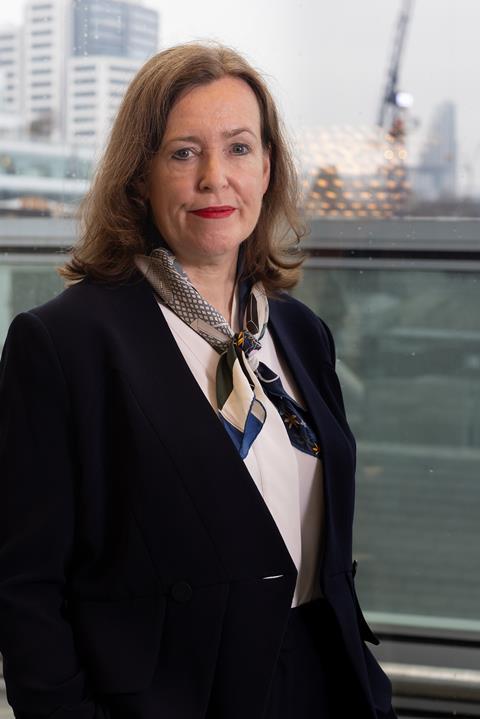
PR: You’ve been in the job now for 100 days. What have you identified as immediate priorities?
SR: Related to what we have been talking about, I would like the regulator to come across as more human and empathetic. This matters because I think the regulator can be seen to be distant from the regulated community.
Let’s take Mazur, for example. Many people were (and are) anxious and stressed about what the regulator is going to do if people find themselves on the wrong side of where the line is currently drawn [on litigation rights]. I was really keen that we put out a statement explaining that we will only take enforcement action in the rarest of circumstances, where people have deliberately sought not to meet the rules. If you have made an inadvertent mistake, we are not in the business of coming after you. I was really keen that we put that message out there, so people could feel less anxious about where we, the SRA, might be. You’ll have seen from the press notice we put out on PM Law that the tone is much more empathetic to the impact on clients, who may be in the middle of trying to buy a house, and the 600 people who have lost their jobs. I want to see that tone of voice and posture, if you like, through all of our work. That’s going to take some time. We can be a regulator holding people to high standards, but do so in a more human way.
PR: PM Law neatly takes us on to the Carson McDowell reports, commissioned by the Legal Services Board, on Axiom Ince and also SSB. How is the SRA going to change its regulatory approach to monitoring accumulator firms in particular?
SR: We obviously have seen some firms fail in a disorderly way. Firms that have grown far too quickly, frankly. Of course, the very act of growing a firm quickly isn’t necessarily in itself a problem if it’s managed well. Firms ought to be able to change their business structures and grow if they’re managed well. I come back to the point that we, as an organisation, need to be better at spotting the risk in those firms and of any business model we think is potentially more of a risk than others. In terms of our overall approach, this is our response to Axiom Ince and SSB. To get better at making sure we’ve got the right data; that we’ve got a good sense of where the risks are; and that we ‘join the dots’ better than we have done in cases in the past.
I’m keen that we work on a culture inside the SRA, so the teams have a culture of curiosity. It’s a really positive, strong culture here, actually – a thousand people trying to do a great job. But is everybody sufficiently curious about what the data is telling us at any one point? I’ve already signalled to the whole organisation that what I’m expecting is that people are more curious about what they see. That they join the dots. They ask questions. They work together as a team. They join up with other teams to spot where there may well be potential harm, and then work at pace to escalate if needed, or to act if needed.
Sarah Rapson
Current role
- Chief executive, Solicitors Regulation Authority, Nov 2025-
Previous roles in regulation and government
- Executive director, supervision, Financial Reporting Council, 2021-2025
- Director, authorisations, Financial Conduct Authority
- Director general, UK Visas and Immigration, Home Office
- Registrar general for England & Wales and chief executive, HM Passport Office
Earlier career (financial services)
- American Express
- Barclays
- Woolwich
Former non-executive roles
- Senior independent director, North Middlesex Hospital NHS Trust
- Non-executive director, Royal Free London NHS Foundation Trust
Education
- MBA, London Business School
- BSc Mathematics, Lancaster University
PR: What additional data will allow you to do that? It’s not the job of a regulator to do due diligence on mergers and acquisitions, is it? Are you talking about getting more management accounts-type information in?
SR: It’s an open question. The teams are working on exactly how we would do that in a way that is proportionate and will help us work out where the risk is. We know we’ve got to get closer to the financial position on the firms that we think have potential for more risk. Exactly how we do it is still in debate. We would consult on that before we made any changes.
PR: Another live issue is the SRA’s approach to prosecutions before the Solicitors Disciplinary Tribunal. On SLAPPs (strategic litigation against public participation) and in the Daily Mail ‘sting’ immigration cases, the SRA has lost them all so far. Is the regulator too quick to ‘jump’ when politicians or the media smell blood?
SR: We’ve had some cases that didn’t go our way recently. I’m not going to talk about individual cases, but of course we will be reflecting on where those cases have got to and seeing what lessons there are going to be for our approach. I mean, you would expect us to do that, wouldn’t you?
PR: You’ve intimated that the number of complaints coming in to the SRA is rising. Are clients simply more querulous these days? Is there a complaints culture? Or is there just more bad behaviour by solicitors?
SR: The first thing I would say in reply is to repeat the point that the vast majority of solicitors behave with integrity and are ethical. But it is striking that in December, for example, we received 1,800 reports about solicitors. And the rate of increase is accelerating. In the last quarter of 2025, complaints rose 80% year on year. Now, whether that means that behaviour is poorer – I don’t think we can conclude that. It is true that artificial intelligence has made it easier for people to be able to complain, to articulate a complaint. In one way, that’s a good thing, because perhaps people who should be complaining feel they’ve got more opportunity to make their point. On the other hand, it also means that more complaints are potentially vexatious. We’ve got to deal with them all properly.
It’s not just us, of course. Talk to the Legal Ombudsman or the Financial Ombudsman Service. Firms have got their own versions of this issue, too, with more volumes coming in. What that means for us is that we have improved our processes. We have brought more people in. We’ve actually outsourced some of our work to contractors, but we are still not keeping up with the volumes.

PR: And that has implications for your budget. More complaints mean more expense – and ultimately solicitors pick up the tab through the practising certificate fee.
SR: That is why we have to be really thoughtful about the cases that we take forward. We will want to have a conversation in 2026 about whether we are in the right place, and what we do and don’t act on. Because keeping on with the same approach, with those sorts of volumes – and also because people say that we are heavy-handed – probably means we do need to look at the model.
PR: In a way, it has to be acknowledged that you can’t win. No one actively wants to have a regulator looking over their shoulder.
SR: Ultimately, it’s a profession, and all professions need to have integrity and be grounded in ethics. If you didn’t have a regulator, I would argue that trust and confidence in the profession wouldn’t be as high. Now, you do need to effectively regulate, to proportionately regulate, and to think about risk. A one-size-fits-all approach is not going to work. But in the end, whether you’re in a law firm, whether you’re a solicitor or whether you’re the regulator, we have shared objectives. Trust and confidence in the profession, protecting consumers. We just have different roles.
PR: If there is one message you would like to convey to solicitors via the pages of the Gazette, what would it be?
SR: I’m excited for the period ahead. I firmly believe that the vast majority of solicitors are doing a great job. It’s really important for regulators to say that. This is a really important profession that contributes £50bn to the UK economy and I am really keen to engage. I want to hear from the profession what it’s like. I want to understand what the issues are.
PR: So I can conclude by saying that you remain very much in listening mode?
SR: Absolutely.
Photographs by Jonathan Goldberg









5 Readers' comments