
























Fee income and profits continue to soar, this year’s benchmarking survey shows. Solicitors are clearly getting better at running their businesses
Some 121 law firms with a combined income of £1.2bn took part in this year’s Law Society Financial Benchmarking Survey. That is a representative sample, but there is a caveat. Firms that volunteer their data are more than casually interested in how best to conduct legal business. It is safe to assume they are relatively well run.
This needs to be borne in mind when contemplating the blizzard of buoyant statistics that follows – as does the fact that the sample varies from year to year. One is not comparing like with like.
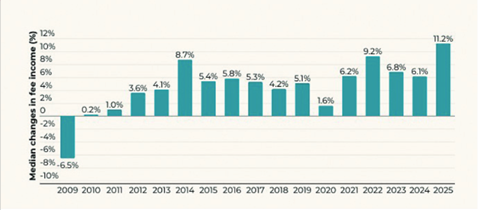
That said, the numbers are impressive. Perhaps the most eye-catching is an 11.2% rise in median fee income, the biggest increase reported for at least 17 years.
Median profit per equity partner is up 13%. That does not quite match last year’s 21%, but is still the second-largest rise since 2014 if one excludes the Covid era outlier of 2021 (+39%).
One question will already have suggested itself to readers who take an interest in law firm finances. How much of the sustained profit boon is attributable to pocketing the interest on client money? Inconveniently, given what came later, last year’s survey showed that interest on client money turbocharged partner profits while organic growth flatlined. In 2025, total interest receipts soared 150% from £28m in 2023 to £69.5m, an average of nearly £500,000 per law firm surveyed.
That has changed. Last year, median PEP rose just 1.2% when interest receipts were excluded. This year, the equivalent figure is 10.5%. Firms appearing to be heeding advice to wean themselves off what has proved a lucrative income stream since interest rates started to rise in 2022.
Total interest income did rise again this year, but by just 11%, far less than previously.
'Despite ongoing external uncertainty and an increased need to invest in new technology, law firms are seeing strong growth. The legal sector remains healthy and resilient'
Mark Evans, president, Law Society
No one is pretending however that it will not hurt the sector if the government presses ahead with plans to seize the interest that law firms earn from client money. Hundreds of responses were dispatched to the government’s ongoing consultation. I understand that we are highly unlikely to see white (or indeed black) smoke from the Ministry of Justice until after the May elections.
Some 85% of respondent firms reported fee growth in 2026, with 55% posting double-digit growth. Rises were recorded across all regions and work types. Conveyancing income rose by a median 27% as the residential property market rebounded.
If the MoJ is to squeeze earnings by seizing interest, there remains scope for law firms to mitigate its impact. Chargeable hours per fee-earner climbed from 752 in 2025 to 807, but against a notional industry standard of 1,000-1,200 hours the sector can hardly boast of its outstanding productivity. As one attendee at the survey’s launch on Tuesday observed drily: ‘I’d be asking fee-earners working a 35-hour week what they are doing during the three or four hours a day they are not charging for their services.’
There are other encouraging signs that firms are getting better at financial hygiene. Median lockup is down from 146 days last year to 134, a notable reduction following years of stasis. And there are still easy wins to be had, such as getting bills sent out promptly and ensuring fee-earners bill throughout the month rather than just once. Every day taken off lockup frees up £30,000 of cash. The billing habit must be ingrained.
What else stands out? The cost of professional indemnity insurance as a proportion of fee income has fallen for the first time in seven years, confirming the endurance of a soft PII market. But the cost of IT – more than 4% – is on the up, as firms address the challenge of exploiting artificial intelligence.
The good times look set to continue to roll, notwithstanding the vexed issue of interest receipts. Looking ahead, the firms that took part this year predict a median rise in fee income of 4.8% in the current period.
Mark Evans, president of the Law Society, commented: ‘Despite ongoing external uncertainty and an increased need to invest in new technology, law firms are seeing strong growth. The legal sector remains healthy and resilient. Solicitors continue to support clients, businesses and communities while heavily contributing to the UK’s economy. With the right support and investment, England and Wales can continue to lead the world as a renowned legal centre.’
The Financial Benchmarking Survey 2026 provides an overview of the financial performance of the legal sector. It is written and produced by the legal team of accountancy firm Hazlewoods LLP for the Law Society Leadership and Management Section and sponsored by Lloyds Bank Commercial Banking
This article is now closed for comment.













3 Readers' comments