

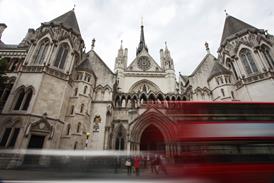




















The Law Society will today urge the Court of Appeal not to override the will of parliament by green-lighting unauthorised staff to conduct litigation.
The solicitors’ representative body will make submissions to the court in Mazur arguing that Mr Justice Sheldon correctly interpreted the law in his ruling last September.
The court will continue hearing this morning from CILEX, which is leading the appeal, before interventions from the Association of Personal Injury Lawyers and Law Centres Network.
The Law Society and Solicitors Regulation Authority will then oppose the appeal. The Society is expected to argue that while many chartered legal executives and other unauthorised people are highly skilled and experienced in the work they do, the Legal Services Act does not permit them to conduct litigation, even under supervision.
In its skeleton argument, seen by the Gazette, the Society states that what CILEX is asking for ‘cannot be reconciled with the policy choice made by parliament’. It adds that that the 2007 act gave effect to the public interest by ensuring that those carrying on reserved legal activities are fit and proper people who are qualified and reguled.

Chancery Lane rejects the submission that this ruling has created factual uncertainty and says the judge recognised that unauthorised individuals can assist authorised people in relation to the conduct of litigation.
The skeleton adds: ‘A well-run law firm ought not to have any real difficulty in identifying a workable dividing line between what an unauthorised individual may and may not properly do in support of the conduct of litigation, with the benefit of guidance from the regulators and professional bodies.’
The Society will tell the court that supervision of a reserved activity such as litigation cannot be equated with carrying on the activity. Indeed, supervision in this context is not the same as an authorised individual exercising ‘actual and effective control in such a way as to be satisfied that the work has been done properly’.
Meanwhile, the SRA is expected to argue that while unauthorised staff can lawfully ‘assist’ in the conduct of litigation, working under supervision is prohibited under the act.
The regulator submits that CILEX’s interpretation allows non-authorised people to exercise professional judgement and make important decisions in litigation themselves, which would undermine the statutory policy which required authorisation in the first place.
The SRA will argue that it is misconceived to seek to identify a list of ‘discrete tasks’ in proceedings that may or may not amount to the conduct of litigation. Its skeleton adds: ‘The key question when determining who, as between a solicitor and their supervisee/assistant, is conducting litigation in any given case is to be answered by identifying which person has assumed responsibility in substance for the conduct of the litigation and exercises professional judgement in respect of it.
‘It is that assumption of professional responsibility and exercise of professional judgement which is the hallmark of the conduct of litigation under the LSA.’
Topics
Mazur Monday: CILEX reveals its arguments as Court of Appeal case set to start

Representative body set to argue that Mazur ruling runs contrary to core purpose of Legal Services Act.
- 1
- 2
 Currently
reading
Currently
reading
Mazur day two: Law Society to urge court to reject CILEX appeal
- 4
- 5











9 Readers' comments